The Short Version
A fan clicks one "buy" button on one website. Behind that button sit a league agreement, a venue contract, a parent company and, in many cases, a reseller the fan never chose. In 2026 those layers changed more than in any year since Live Nation and Ticketmaster merged in 2010.
GoodSeats.com mapped who owns each ticketing brand and who holds the official deals across sports, concerts and Broadway. The map below shows those relationships in one picture. Six findings stand out:
- Ticketmaster belongs to the largest concert promoter. Live Nation Entertainment owns Ticketmaster. On April 15, 2026, a federal jury found that the companies illegally monopolized ticketing markets, in a case pressed by more than 30 state attorneys general.
- Each league chooses its own "official" marketplace, and the choices do not match. Ticketmaster holds the NFL, NBA and NHL. SeatGeek holds MLB. StubHub, TicketNetwork and four other marketplaces also carry MLB designations.
- One league owns its own box office. Major League Baseball owns Tickets.com, a primary ticketing system used by many of its clubs. That ownership helps explain why baseball opened its ticket inventory to multiple marketplaces before any other major league.
- Broadway is divided by landlord. Shubert theaters sell through Telecharge, Nederlander theaters through Broadway Direct, and ATG theaters through ATG Tickets. MARI, the company founded by Ari Emanuel, owns TodayTix and agreed in August 2026 to buy ATG.
- Familiar names changed hands. Eventbrite was bought by Bending Spoons. DICE belongs to Fever. See Tickets belongs to CTS Eventim. On November 19, 2026, Vivid Seats agreed to give its lenders about 80% of its stock.
- The first price shown must be the price paid. Since May 12, 2025, a Federal Trade Commission rule has required the total price, mandatory fees included, to be shown upfront on live-event tickets, resale included.
None of this identifies a "best" site. It identifies who stands behind each button, so that a buyer compares like with like.
The 2026 Ticketing Map
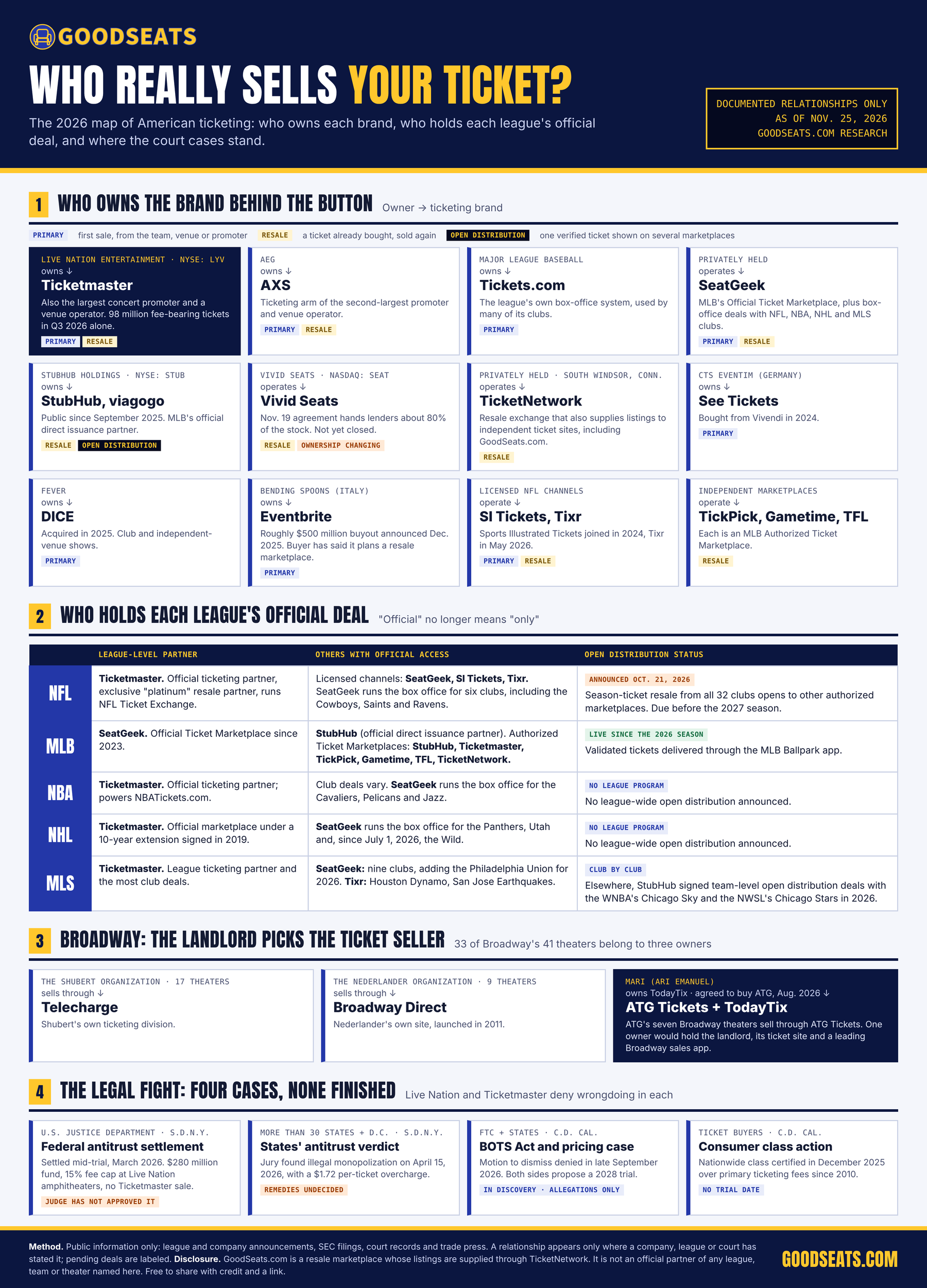
The map is free to share and republish with credit to GoodSeats.com and a link to this page. To place it on a website, copy this code:
<a href="https://www.goodseats.com/seat-report/who-really-sells-your-ticket/"><img src="https://www.goodseats.com/assets/img/seat-report/who-really-sells-your-ticket-2026-map.png" alt="Who Really Sells Your Ticket? The 2026 Map of American Ticketing, from GoodSeats.com" width="900"></a><p>Source: <a href="https://www.goodseats.com/seat-report/who-really-sells-your-ticket/">GoodSeats.com</a></p>Three Terms That Make the Map Readable
Ticketing has its own vocabulary, and most confusion at checkout traces back to three terms.
- Primary ticketing is the first sale of a ticket, made on behalf of the team, venue or promoter. The company that runs it is the primary ticketer or box-office system.
- Resale, also called the secondary market, is the sale of a ticket that has already been bought once. The seller is a fan, a season-ticket holder or a professional broker.
- Open distribution, which Major League Baseball calls direct issuance, is a model in which the rights holder sends verified ticket inventory to several authorized marketplaces at the same time. One ticket is listed once and appears on many sites.
A fourth term matters less often but explains a great deal: a speculative listing is an offer to sell a ticket the seller does not yet hold. Speculative listings are the source of many resale disputes, and they are the target of several new state laws.
The Ownership Layer: Who Is Behind Each Brand
Ownership determines incentives. A ticketing brand owned by a promoter, a league or a theater landlord does not behave like an independent marketplace, and a buyer benefits from knowing which is which.
| Brand | What it sells | Owner | Status in November 2026 |
|---|---|---|---|
| Ticketmaster | Primary and resale | Live Nation Entertainment (NYSE: LYV) | Lost the states' antitrust trial in April; remedies are undecided |
| AXS | Primary and resale | AEG | Ticketing arm of the second-largest promoter and venue operator |
| Tickets.com | Primary | Major League Baseball | Box-office system for many MLB clubs |
| SeatGeek | Primary and resale | Privately held | MLB's Official Ticket Marketplace; box-office partner for clubs in four leagues |
| StubHub and viagogo | Resale and open distribution | StubHub Holdings (NYSE: STUB) | Public since September 2025; $2.62 billion in third-quarter gross sales |
| Vivid Seats | Resale | Vivid Seats Inc. (Nasdaq: SEAT) | Lenders to receive about 80% of the stock; transaction not yet closed |
| TicketNetwork | Resale | Privately held, South Windsor, Connecticut | MLB Authorized Ticket Marketplace since March 2026 |
| See Tickets | Primary | CTS Eventim | Bought from Vivendi in 2024 |
| DICE | Primary | Fever | Acquired in 2025 |
| Eventbrite | Primary, mostly smaller events | Bending Spoons | Roughly $500 million buyout announced in December 2025 |
Live Nation and Ticketmaster
Live Nation promotes tours, operates venues and owns Ticketmaster. That combination is the reason the company sits at the center of the map and at the center of four lawsuits. The business itself continues to grow. Live Nation reported revenue of $10.1 billion for the third quarter of 2026, an increase of 19%, and Ticketmaster handled 98 million fee-bearing tickets in the quarter.
The Resale Marketplaces
The resale side is consolidating around balance sheets. StubHub completed its initial public offering in September 2025 and raised its 2026 gross sales outlook to between $10.18 billion and $10.38 billion. Vivid Seats moved in the opposite direction. Under the agreement it announced on November 19, 2026, lenders exchange about $273 million of secured debt for roughly 45.8 million new shares, which leaves existing shareholders with about 20% of the company. No single lender would hold more than 19.99%, and the transaction still requires near-unanimous lender participation to close.
The Layer Most Buyers Never See
Many ticket websites do not hold their own inventory. They display listings supplied by a resale exchange, a business that pools tickets from brokers and season-ticket holders and distributes them to partner sites. TicketNetwork is one such exchange. The practical consequence is that two websites with different names can show the same seat from the same seller, because both draw from the same pool.
GoodSeats.com is part of that layer, and readers should know it: the ticket listings on this site are supplied through TicketNetwork. A full disclosure appears at the end of this article.
Sports: One League, Several "Official" Doors
In sports, "official" no longer means "only." Leagues now license several marketplaces, and the largest shift of 2026 is toward open distribution.
| League | League-level partner | Others with official access | What changed in 2026 |
|---|---|---|---|
| NFL | Ticketmaster: official ticketing partner, exclusive "platinum" resale partner, operator of NFL Ticket Exchange | SeatGeek, Sports Illustrated Tickets and Tixr, as licensed channels of NFL Ticket HQ | October 21 agreement opens season-ticket resale from all 32 clubs to other authorized marketplaces before the 2027 season |
| MLB | SeatGeek: Official Ticket Marketplace since 2023 | StubHub (official direct issuance partner); Authorized Ticket Marketplaces StubHub, Ticketmaster, TickPick, Gametime, TFL and TicketNetwork | Direct issuance launched for the 2026 season; TicketNetwork added in March |
| NBA | Ticketmaster: official ticketing partner; powers NBATickets.com | Club agreements vary; SeatGeek serves the Cavaliers, Pelicans and Jazz | Cavaliers renewed with SeatGeek on October 29; no league-level change found |
| NHL | Ticketmaster: official marketplace under a 10-year extension announced in 2019 | SeatGeek serves the Florida Panthers, Utah Mammoth and Minnesota Wild | The Wild moved to SeatGeek on July 1 |
| MLS | Ticketmaster: league ticketing partner with the most club agreements | SeatGeek (nine clubs, including the Philadelphia Union from 2026); Tixr (Houston Dynamo, San Jose Earthquakes) | More clubs on systems other than Ticketmaster |
MLB: The League That Owns Its Own Box Office
Baseball built the most open system in American sports, and the structure explains why. MLB owns Tickets.com, so the league controls a large share of its own primary ticketing. In February 2023 it named SeatGeek its Official Ticket Marketplace. One month later it created the Authorized Ticket Marketplace program, a set of non-exclusive agreements under which approved resale sites are connected to the league's ticketing system. StubHub was the first member.
The 2026 season added two pieces. StubHub's direct issuance technology began distributing primary inventory, meaning tickets sold for the first time, through StubHub and other authorized marketplaces. TicketNetwork joined the program in March. Tickets bought through an authorized marketplace are validated in MLB's system and delivered through the MLB Ballpark app, which removes much of the fulfillment risk that has long troubled resale.
NFL: "Ticketing 3.0"
Until this year, Ticketmaster alone had comprehensive access to the resale inventory of NFL season-ticket holders. The agreement announced on October 21, 2026, changes that. Under a model the league calls Ticketing 3.0, an eligible season-ticket member lists a ticket once and the listing is distributed to every participating authorized marketplace. Ticketmaster remains the league's exclusive top-tier resale partner and continues to operate NFL Ticket Exchange.
Three details deserve attention. First, the timing: the league expects implementation ahead of the 2027 season. Second, the unfinished business: SeatGeek has reached an agreement in principle to join at a new partner tier, according to trade reports, but that agreement is not final, and the league has not said how fees will work. Third, the direction: NFL officials told Sports Business Journal in November that the new model could move the league closer to owning its own ticketing platform, although no decision has been made.
The NFL also maintains licensed channels, companies permitted to work directly with clubs. That group now numbers three alongside Ticketmaster: SeatGeek, Sports Illustrated Tickets, which joined in 2024, and Tixr, which joined in May 2026. SeatGeek already operates the box office for six clubs: the Dallas Cowboys, New Orleans Saints, Arizona Cardinals, Washington Commanders, Baltimore Ravens and Tennessee Titans.
NBA, NHL and MLS: Club by Club
The NBA and NHL have league-level agreements with Ticketmaster but no league-wide open distribution program. The NBA's own ticket site states that Ticketmaster provides the transaction system most clubs use, and it links to the primary ticketing partner of each club that uses another provider. For a buyer, the practical rule is simple: the official seller is whichever company the home club has hired, and that can differ from one arena to the next.
The trend also reaches beyond the largest leagues. In May 2026 the WNBA's Chicago Sky named StubHub its official open distribution partner, a first for a WNBA team. The NWSL's Chicago Stars and the American Conference in college athletics signed similar agreements in July.
Concerts: One Giant and a Handful of Challengers
Concert ticketing is the most concentrated part of the map. A concert venue signs a contract with one primary ticketer, usually for several years, and every show in the building sells through that company. The Federal Trade Commission's 2025 complaint alleges that Ticketmaster controls 80% or more of primary ticketing for major concert venues. Live Nation disputes that it is a monopoly.
The challengers hold specific positions rather than broad ones. AXS serves venues owned or operated by AEG. SeatGeek has grown through sports venues that also host concerts, such as the Minnesota Wild's arena. See Tickets, DICE and Eventbrite serve clubs, festivals and independent promoters. Eventbrite's new owner has said it plans to add a resale marketplace, which would turn another primary seller into a reseller as well.
Two pending developments could change what concertgoers see. The Justice Department's proposed settlement would cap Ticketmaster service fees at 15% at Live Nation amphitheaters and would let rival sellers offer a share of the tickets to some shows at those venues. The states that won the jury verdict are seeking stronger remedies. Neither outcome is final.
Theater: On Broadway, the Landlord Picks the Ticket Seller
Broadway does not run on one system. The company that owns the theater decides who sells its box-office tickets, so two shows on the same block can use different websites. Three owners control 33 of Broadway's 41 theaters.
| Theater owner | Broadway theaters | Official seller | What to know |
|---|---|---|---|
| The Shubert Organization | 17 | Telecharge | Telecharge is Shubert's own ticketing division |
| The Nederlander Organization | 9 | Broadway Direct | Nederlander launched Broadway Direct in 2011 |
| ATG Entertainment | 7 | ATG Tickets | Includes the Lyric, Hudson and Al Hirschfeld; StubHub is ATG's official resale partner |
The ATG column changed twice in two years. Five of its theaters came from Jujamcyn, which had used SeatGeek as its primary ticketer; those houses finished moving to ATG Tickets in 2025. Then, on August 11, 2026, MARI announced an agreement to acquire ATG Entertainment. MARI had already bought TodayTix Group, a major Broadway sales app, in October 2025.
If the ATG purchase closes, one owner will stand behind a Broadway landlord, its ticketing site and a leading Broadway sales app. Nothing in the public record suggests that fans are paying more because of it. It remains a relationship worth knowing when comparing prices.
Touring Broadway is a separate matter. Road productions sell through whatever system the local venue uses, which is often Ticketmaster.
The Legal Fight: Four Cases, None Finished
Live Nation and Ticketmaster lost a jury verdict this year, but no company has been broken up and no remedy is final. Four cases are moving on separate tracks, and the companies deny wrongdoing in each.
| Case | Who brought it | Where it stands in November 2026 |
|---|---|---|
| Federal antitrust settlement, Southern District of New York | U.S. Justice Department, filed 2024 | Settled one week into trial in March 2026. The proposed final judgment was filed June 12. Judge Arun Subramanian has not yet ruled on whether it serves the public interest. |
| States' antitrust claims, same court | More than 30 states and the District of Columbia, which declined the settlement | Jury found illegal monopolization on April 15, 2026, including a $1.72 per-ticket overcharge. Motions to overturn the verdict were argued July 31 and remain undecided. Remedies discovery is paused. |
| BOTS Act and consumer protection case, Central District of California | Federal Trade Commission and seven states, filed September 2025 | Motion to dismiss denied in late September 2026. The government has proposed an April 2028 jury trial; the companies have proposed an October 2028 bench trial. The claims are allegations, not findings. |
| Consumer class action, Central District of California | Ticket buyers | Nationwide class certified in December 2025, covering primary ticketing fees paid since 2010. No trial date. |
What the Federal Settlement Would Do
The proposed settlement, if approved, would create a $280 million fund for states, cap service fees at 15% at Live Nation amphitheaters, impose obligations covering 13 amphitheaters, and extend federal oversight by eight years. It does not require Live Nation to sell Ticketmaster. Independent venues, rival ticketers and the states that went to trial have told the court that it falls short.
Why the FTC Ruling Reaches Beyond Ticketmaster
The Better Online Ticket Sales Act, known as the BOTS Act, is a 2016 federal law aimed at software that evades purchase limits. In denying the motion to dismiss, the California court wrote that the law "does not preclude platforms from facing liability," according to Pollstar's report on the ruling. That reading extends the statute from the brokers who use bots to the marketplaces where their tickets are resold, and it is likely to be tested on appeal.
Rules Already in Force
Two sets of rules apply today regardless of how the lawsuits end.
- The federal fee rule. The FTC's Rule on Unfair or Deceptive Fees took effect on May 12, 2025. It requires the total price, including mandatory fees, to be displayed upfront for live-event tickets on primary and resale sites alike.
- State resale laws. Vermont's governor signed a law on May 26, 2026, that caps resale prices at 110% of the original ticket price and bans speculative tickets. Maine limits the fee a resale marketplace may charge to 10% of the original ticket's total price and also requires total-price disclosure.
Congress has not finished its own work. The TICKET Act, which would write all-in pricing into federal statute, passed the House in April 2025 and has been reported by a Senate committee, but the full Senate has not voted on it.
How to Use the Map: A Buyer's Checklist
The map is useful only if it changes how a buyer shops. Seven checks apply to any game, concert or show.
- Find the official seller first. Use the tables above, or the team's, venue's or theater's own website. Note the face value before looking at resale.
- Compare total prices, not list prices. U.S. sellers must show the total upfront. A fee that appears only at checkout is a warning sign. The GoodSeats guide to ticket fees explains each charge.
- Know whether the ticket is primary or resale. The same seat can appear on several sites. Under open distribution, it may be the same ticket.
- Check how the ticket is delivered. Verified tickets usually arrive through the team's or venue's own app, such as the MLB Ballpark app. Avoid screenshots and PDFs from strangers. The guide to mobile ticket transfer covers the process.
- Ask whether the seller holds the ticket. A listing for a ticket the seller does not yet have is a speculative listing. Some states now ban them; most events do not block them.
- Pay with a credit card. A card provides a dispute route if the ticket never arrives. The guide to avoiding ticket scams lists the other protections.
- For Broadway, try the lottery and rush programs first. Telecharge, Broadway Direct and TodayTix all run official discount programs, described in the guide to Broadway lottery, rush and standing room.
Once the seller is settled, the remaining question is the seat itself. The companion article, Same Seat, Five Websites, applies this map to choosing and pricing a specific seat.
Method and Disclosure
Method. This map uses public information only: league and company announcements, Securities and Exchange Commission filings and earnings releases, court records and trade press, current as of November 25, 2026. A relationship counts as documented only when a company, league or court has stated it. Agreements that are reported but not final, such as SeatGeek's new NFL tier, the Vivid Seats recapitalization and MARI's purchase of ATG, are labeled that way. Ticketing agreements change often, and corrections are welcome through the corrections page.
Disclosure. GoodSeats.com is operated by iDigits LLC. It is a resale marketplace, and the ticket listings and checkout on this site are supplied through TicketNetwork, which is named in this article. GoodSeats.com is not an official partner of any league, team, venue or theater named here.
Frequently asked questions
Does Live Nation own Ticketmaster?
Yes. Live Nation and Ticketmaster merged in 2010, and Ticketmaster is a wholly owned subsidiary of Live Nation Entertainment.
Is Ticketmaster being broken up?
Not as of November 2026. The Justice Department's proposed settlement lets Live Nation keep Ticketmaster. A jury sided with the states in April 2026, but the remedies, which the states want to include a separation, have not been decided.
What is the official ticket marketplace of the NFL?
Ticketmaster. Under the October 2026 agreement it remains the NFL's exclusive top-tier resale partner, and other authorized marketplaces will gain access to season-ticket resale listings before the 2027 season.
What is the official ticket marketplace of MLB?
SeatGeek, since 2023. StubHub is MLB's official direct issuance partner, and StubHub, Ticketmaster, TickPick, Gametime, TFL and TicketNetwork are Authorized Ticket Marketplaces.
Who owns StubHub, Vivid Seats and SeatGeek?
StubHub Holdings is publicly traded on the New York Stock Exchange. Vivid Seats trades on Nasdaq and has agreed to give its lenders about 80% of its stock. SeatGeek is privately held.
Who owns Telecharge, Broadway Direct and TodayTix?
Telecharge is part of the Shubert Organization. Broadway Direct belongs to the Nederlander Organization. TodayTix belongs to MARI, which has also agreed to buy ATG Entertainment.
Do ticket prices have to include fees?
Yes, in the United States. The FTC's Rule on Unfair or Deceptive Fees has required upfront total pricing for live-event tickets since May 12, 2025, on primary and resale sites.
What is open distribution in ticketing?
Open distribution is a model in which a verified ticket is listed once by the rights holder or season-ticket holder and shown on several authorized marketplaces at the same time. MLB launched it for the 2026 season, and the NFL announced its version in October 2026.
Sources
- Ticketmaster announcement, October 21, 2026
- TicketNews on the resale model
- TicketNews on timing and a league-owned platform
- NFL.com
- Sportcal on Tixr
- Baltimore Ravens on SeatGeek clubs
- MLB.com on SeatGeek
- MLB on Authorized Ticket Marketplaces
- StubHub on direct issuance
- TicketNews on TicketNetwork
- Hartford Business Journal
- NBATickets.com FAQ
- TicketNews on the Cavaliers
- NHL.com on Ticketmaster
- Minnesota Wild
- SeatGeek and the Philadelphia Union
- Chicago Sky
- StubHub on the Chicago Stars
- TicketNews on the American Conference
- Live Nation third-quarter 2026 release
- StubHub third-quarter 2026 release
- Vivid Seats recapitalization release
- Eventbrite and Bending Spoons
- Billboard on Eventbrite's resale plans
- TheaterMania on MARI and ATG
- The Hollywood Reporter on TodayTix
- TicketNews on ATG Tickets and StubHub
- Live Nation Form 10-Q, third quarter 2026
- Paul, Weiss on the verdict
- Crowell & Moring on next steps
- TicketNews on post-trial motions
- Pollstar on the BOTS Act ruling
- TicketNews on proposed trial dates
- Hypebot case tracker
- FTC fee rule FAQ
- Music Business Worldwide on Vermont
- Maine Attorney General
- TICKET Act, H.R. 1402