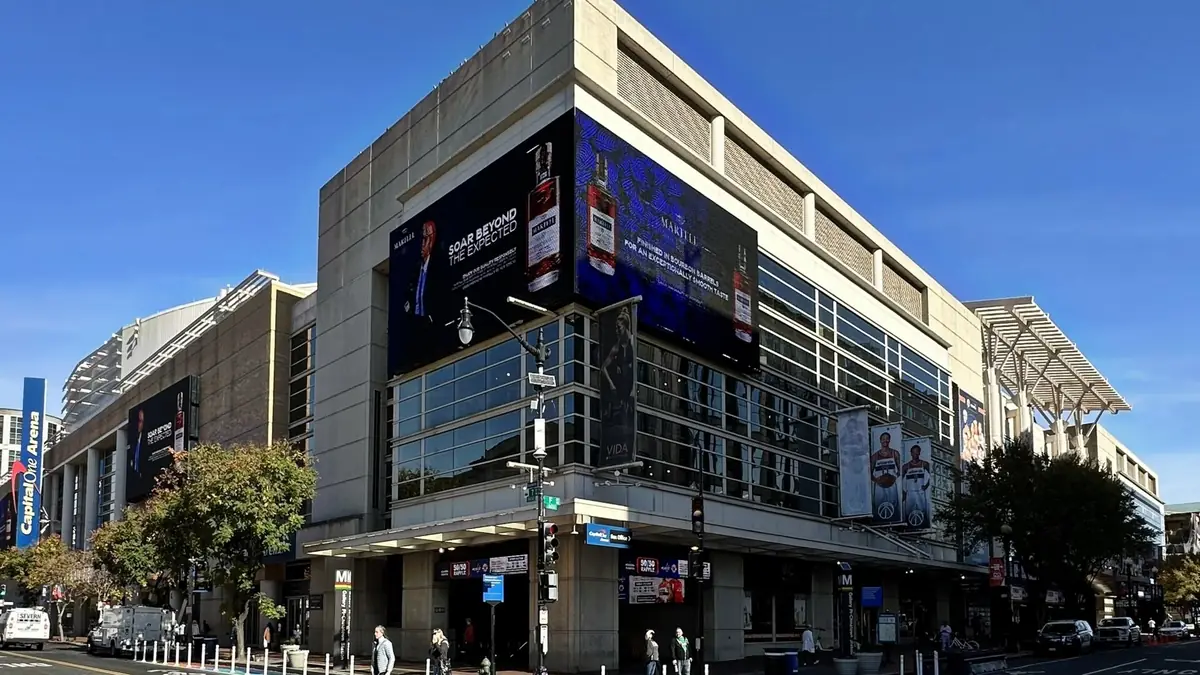

Upcoming events at Capital One Arena
Dates and live ticket listings appear here as soon as they are on sale. The guide below covers what to know before you buy.
Downtown Washington's Arena at Gallery Place
Capital One Arena is the indoor arena at 601 F Street NW in Washington, D.C., in the Chinatown and Penn Quarter neighborhoods. It opened on December 2, 1997, as the MCI Center and is home to the Washington Capitals (NHL), the Washington Wizards (NBA) and Georgetown Hoyas men's basketball, along with concerts, wrestling and family shows. It seats 20,356 for basketball and 18,573 for hockey. The short answer on seats: the center sections of the 100 level are the best views, and the low rows of the center 400 level are the best value.
The arena's best feature is its location. The Gallery Place–Chinatown Metro station sits directly beneath it, and three more stations are within walking distance, so most fans never need a car. Owner Monumental Sports & Entertainment has committed both teams to the building through at least 2050 and is renovating it in phases.
Capital One Arena Seating Chart, Explained
The arena has three public seating levels. Seating guides and seat-view databases agree on the section ranges:
- 100 level, sections 100–121: the lower bowl. Section 100 sits at center on one sideline, and the numbers run around the bowl so that sections 110–112 are at center on the opposite side. The ends sit at roughly sections 105–106 and 116–117. Court-side and ice-level seating carries names such as Box and Gold sections.
- 200 level, sections 200–229: the club level, with padded seats and access to club food and drink. The Acela Club, a reservation-based restaurant area, is between sections 200 and 205.
- 400 level, sections 400–433: the upper bowl. Luxury suites occupy the floors between the club level and the 400s, and seat-view databases list no 300-numbered public sections.
For hockey, seating guides place the Capitals bench between sections 100 and 121 and the visitors' bench between sections 100 and 101, with the penalty boxes in front of section 111. That makes section 100 and its neighbors the center-ice sideline closest to both benches.
Best Seats for Capitals, Wizards and Concerts
Capitals hockey
The center-ice sections, 100, 101, 110–112 and 121, give the best full-ice view. The Capitals shoot twice on the net in front of sections 105 and 106, so that end is the choice if you want to watch the home team attack for two periods. For a whole-game view on a budget, the low rows of the center 400s (around 400, 401, 433 and 416–418) beat lower-bowl seats in the corners: you see plays and line changes develop, and prices usually step down sharply.
Wizards and Georgetown basketball
The same center sections are the premium seats for basketball, and corner sections in the 100 level are the smart compromise. Basketball has shorter sightlines than hockey, so the 200-level club seats on the sides feel close, and the center 400s still work well for following the game.
Concerts and shows
Most concerts use an end stage, which removes or limits the sections behind it. Side sections in the 100 level closest to the stage and the 200-level club seats on the sides are the strongest reserved seats. Floor tickets put you closest, but the view depends on the crowd in front of you.
Capital One Arena Seats to Avoid
- Rows 2–7 behind the hockey glass. Seating guides note that the glass distorts and interrupts the view at these heights. Row 1 is close enough for the experience; higher rows see more of the ice.
- Seats directly behind the penalty boxes in section 111. The aisle seats beside the boxes are fun for close-up action, but rows straight behind the boxes look through extra glass and people.
- Behind-the-stage sections at concerts. Buy them only when the listing says side or rear view.
- The top rows of the 400-level corners. The view is distant. A low row in the center 400s is usually the better buy.
Metro, Parking and Rideshare at Capital One Arena
Metro is the best option. Gallery Place–Chinatown, served by the Red, Green and Yellow lines, is directly beneath the arena. Judiciary Square, Metro Center and Archives–Navy Memorial–Penn Quarter are all within walking distance. From Ronald Reagan Washington National Airport, the Yellow Line runs directly to Gallery Place.
Watch the closing time. As posted by the arena in 2026, Metro runs until 11:30 p.m. Monday through Thursday, 1 a.m. on Friday and Saturday and 11 p.m. on Sunday. A weeknight concert or an overtime game can end close to the last train, so check WMATA's current hours before you go.
Parking. The arena has its own garage, and as of 2026 it partners with SpotHero for reservations at nearby lots and garages. Downtown garages fill quickly for Capitals and Wizards games, and driving into the Penn Quarter grid after work is slow. If you must drive, reserve a spot in advance and expect rates to change by event.
Rideshare. Pickup after a game is congested on the surrounding streets. Walking a few blocks away from F Street before requesting a car usually saves time.
Capital One Arena Bag Policy (as of 2026)
As of fall 2026, bags, backpacks and purses are not permitted inside Capital One Arena. Wallet-size clutches no larger than 4 by 6 inches are allowed, along with medical bags and parenting bags no larger than 14 by 14 by 6 inches. All permitted bags are screened, and guests carrying medical or parenting bags should use the 6th and F Street entrance. Policies change, so read the arena's current policies before you go.
- Food and water: outside food and drink are not allowed, but one empty plastic water bottle per person is permitted.
- Smoking: the arena is smoke- and vape-free. Smoking is allowed only outdoors at least 25 feet from the building.
- Renovation: the building is being renovated, with completion expected around the 2027–28 seasons, so entrances, concourses and clubs may change from one season to the next. Check the arena's know-before-you-go page for the event you are attending.
Every order on GoodSeats comes with free shipping.
From MCI Center to a Renovated Capital One Arena
Ground was broken on October 18, 1995, and the arena opened on December 2, 1997, at a cost of about 260 million dollars. It replaced the former arena in suburban Landover, Maryland, as home of the Capitals and the team now called the Wizards. It was the MCI Center until 2006 and the Verizon Center until 2017, when it became Capital One Arena. The Washington Mystics played here from 1998 to 2018.
The building hosted Games 3 and 4 of the 2018 Stanley Cup Final, both Capitals wins on the way to the franchise's first title. On December 13, 2023, Monumental announced plans for a new arena in Alexandria, Virginia, but the plan fell apart, and in March 2024 Mayor Muriel Bowser announced a deal to keep the Capitals and Wizards in the District at least until 2050. The renovation that followed includes 515 million dollars from the District, with completion expected around the 2027–28 seasons. Event listings are on the official Capital One Arena site.
Frequently asked questions
What is the capacity of Capital One Arena?
Capital One Arena seats 20,356 for basketball, 18,573 for hockey and about 19,300 for wrestling.
Can I bring a bag into Capital One Arena?
As of fall 2026, bags, backpacks and purses are not allowed. Clutches up to 4 by 6 inches and medical or parenting bags up to 14 by 14 by 6 inches are permitted after screening. Check the arena's current policy before you go.
What Metro stop is closest to Capital One Arena?
Gallery Place–Chinatown, on the Red, Green and Yellow lines, is directly beneath the arena. Judiciary Square, Metro Center and Archives are also within walking distance.
Is there parking at Capital One Arena?
The arena has a garage, and as of 2026 it sells reservations at nearby lots and garages through SpotHero. Rates vary by event, and Metro is usually faster.
Where do the Capitals shoot twice?
Seating guides report that the Capitals shoot twice on the net in front of sections 105 and 106.
Are the Capitals and Wizards moving out of Capital One Arena?
No. A 2023 plan to move to Alexandria, Virginia, was dropped, and a March 2024 agreement with the District keeps both teams downtown at least until 2050 while the arena is renovated.