
Upcoming events at Michigan Stadium
Dates and live ticket listings appear here as soon as they are on sale. The guide below covers what to know before you buy.
The Big House: Michigan football's home since 1927
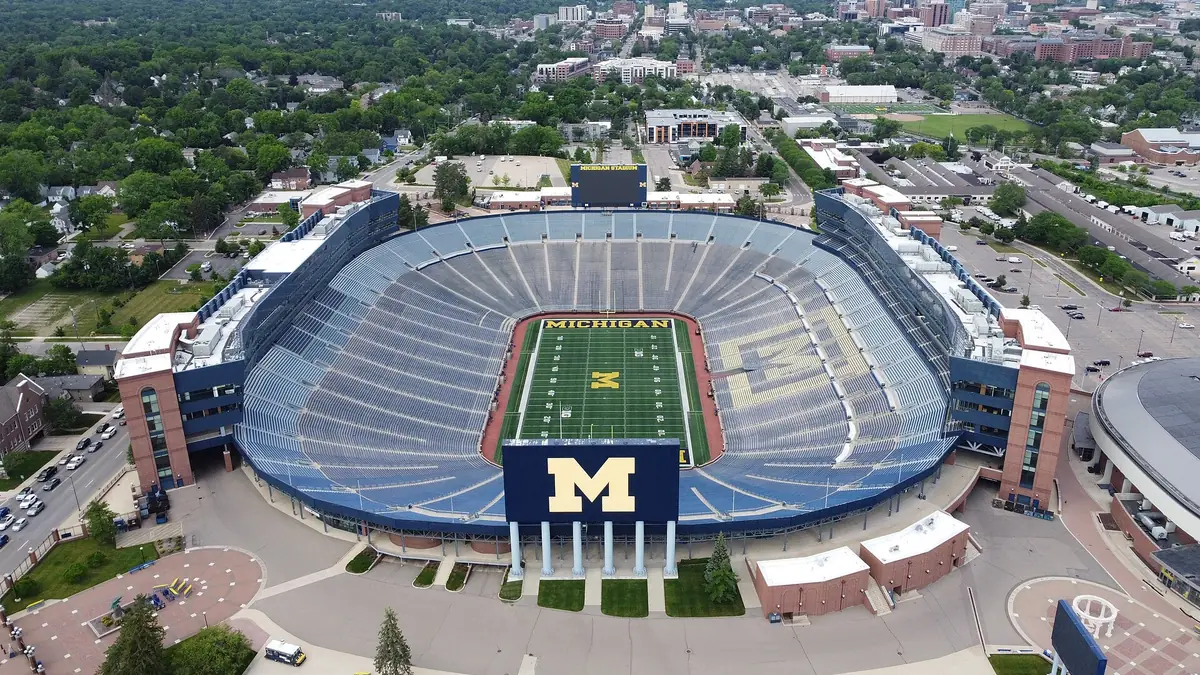
Michigan Stadium, known as the Big House, is the University of Michigan's football stadium in Ann Arbor and the largest stadium in the United States. Its official capacity is 107,601, and crowds have gone well past that: 115,109 watched Michigan beat Notre Dame on September 7, 2013. Every Michigan home game since November 8, 1975, has drawn more than 100,000 fans.
The Michigan Wolverines play six or seven home games a season, on Saturdays from late August or early September through late November, as members of the Big Ten. The university plans around noon, 3:30 p.m. and night kickoffs, and the exact time is often listed as to be announced until shortly before the game, so book travel with some flexibility.
The stadium also hosts the university's main commencement ceremony and has staged record-setting events outside college football, including the 2014 NHL Winter Classic between the Toronto Maple Leafs and Detroit Red Wings, which drew 105,491, and a 2014 soccer match between Real Madrid and Manchester United that drew 109,318.
Michigan Stadium seating chart: one bowl, 44 sections, up to 98 rows
The Big House is a single, continuous seating bowl. There is no upper deck; instead, most of the bowl was dug into the ground, so you enter near the top or middle and walk down. That is why the stadium looks smaller from the street than it is.
Seating guides describe the layout like this:
- Sections: numbered around the bowl, with the east sideline covering Sections 1 to 4 and 42 to 44, and the west sideline covering Sections 20 to 26. The end zones and corners fill the numbers in between.
- Rows: each section runs up to 98 rows deep. Rows A and B sit at the front, followed by numbered rows.
- Tunnels: entry tunnels open midway up the bowl, at rows 56 and 74 on the east side and row 72 on the west, so seats near those rows mean less climbing.
- Seats: almost all seating is bench-style aluminum bleachers. Chairback seats are limited, chiefly in the upper rows of the west sideline (rows 85 and up in Sections 22 to 24), plus the club seats.
According to seating guides, the Michigan sideline is in front of Sections 22 to 24 on the west side, and student seating fills Sections 26 to 33 plus parts of 25 and 34. A 2010 renovation added sideline structures with 83 luxury boxes and 3,200 club seats; the university lists indoor and outdoor club seating on the east sideline.
The university sells seats in pricing tiers named Victors, Valiant, Maize, Blue and End Zone, so a listing's tier tells you roughly where on the bowl it sits.
Where to sit at the Big House
In a stadium this deep, the row matters as much as the section. Row 10 and row 90 in the same sideline section are completely different experiences.
Best views
Sideline sections between the 30-yard lines, in rows roughly 25 to 60, give the best balance. That range is low enough to feel close and high enough to see the whole field. The lowest rows sit close to field level, where players and staff on the sideline can block part of the view. Fans who want to see the Wolverines up close should look at the west side around Sections 22 to 24.
Atmosphere
The student section, around Sections 26 to 33, is the loudest part of the stadium. Neighboring sections share the noise without the obligation to stand for four hours.
Seats to think twice about
- Very high rows in the end zones: long sightlines to the far goal line, with nothing above you but sky.
- Low end-zone rows: you see the near end zone well and the rest of the field at a flat angle.
- Middle-of-row bench seats for a sold-out rivalry game: benches have no armrests, so a full row packs in tight and getting out at halftime is slow.
There is no roof and very little cover, so dress for the weather. The field runs north to south, so in a late-afternoon game the sun sits over the west rim, in the eyes of fans on the east sideline. September games can be hot; November games can be bitter.
Demand peaks for rivalry games against Ohio State and Michigan State in the years they come to Ann Arbor, and for night games. Early-season non-conference games are usually the easiest tickets to find.
Michigan Stadium parking, FootballRide shuttles and road closures
Parking at the Big House is a mix of university lots, school lots, a golf course and front lawns. As of the 2026 season, many university lots are permit-only. The Blue Lot is sold to season ticket holders based on priority points, while the Maize and Brown lots offer day-of sales on site, subject to capacity. Pioneer High School, the Ann Arbor Golf and Outing course and many private businesses and residences also sell gameday parking. Lots open between 6 a.m. and noon, depending on the lot and kickoff time, and vehicles must leave within two hours after the game or face towing. Charcoal and wood grills are not allowed in university lots.
Expect a vehicle-free zone around the stadium. South Main Street and East Keech Street close three hours before kickoff, and for 2026, East Hoover Street between South Division and Greene streets closes 90 minutes before kickoff. After the game, Main Street runs one way southbound toward I-94.
The easier option for many visitors is TheRide's FootballRide shuttle, which runs from hotels and parking sites around Ann Arbor for a small fare paid by mobile ticket or exact cash. Buses run about every 20 minutes starting two hours before kickoff, with the last ones leaving 30 minutes before kickoff, and drop fans near Gate 2 next to Crisler Center. Return buses start when the game ends and run for about an hour. There are no hotels within walking distance of the stadium, so book early and plan on a shuttle or a long walk. See the university's football parking page for current lots.
Michigan Stadium bag policy and gameday entry (2026)
Michigan's rule is stricter than the clear-bag policies used at most big stadiums. As of the 2026 season, all bags are prohibited, including purses, clear bags and fanny packs. Fans with medical or childcare needs, such as prescriptions or diapers, must enter through a bag exception gate (Gate 3 at the south end or Gate 9 West at the north end), where one appropriately sized bag is inspected and tagged. Check the university's stadium safety page for the current policy before you go.
- Also prohibited: all bottles (including empty water bottles), outside food, umbrellas, strollers and infant car seats, seat cushions with pockets or backs, and video cameras.
- Allowed: blankets and rain gear, foam seat pads without pockets, binoculars without cases, phones and small cameras.
- Gates: open two hours before kickoff.
- Children: under the Big Ten policy, everyone needs a ticket, including infants carried in arms or packs.
GoodSeats orders include guaranteed entry and no digital transfer fees.
How the Big House grew
Michigan built the stadium in 1927 for about 950,000 dollars, with an original capacity of 72,000, to replace Ferry Field. Athletic director Fielding Yost insisted on footings strong enough for later expansion, and the bowl has grown repeatedly since. Michigan beat Ohio Wesleyan 33 to 0 in the first game on October 1, 1927, and beat Ohio State 21 to 0 at the formal dedication three weeks later.
A press box added in 1956 raised capacity to 101,001, and every official figure since has ended in 01; campus lore says the extra seat is reserved for former athletic director Fritz Crisler. Broadcaster Keith Jackson is credited with popularizing the Big House nickname by the mid-1980s. The 226-million-dollar renovation completed in 2010 widened seats and aisles and added luxury boxes, club seats and accessible seating. The first night game, on September 10, 2011, ended Michigan 35, Notre Dame 31, and new north and south video boards, each 152 by 55 feet, arrived in 2023.
Frequently asked questions
What is the capacity of Michigan Stadium?
Michigan Stadium's official capacity is 107,601, the largest in the United States. The record crowd is 115,109, set against Notre Dame in 2013.
Can you bring a bag into Michigan Stadium?
As of the 2026 season, no bags are allowed, including clear bags and purses. Medical and childcare bags are inspected at Gate 3 or Gate 9 West.
Which side is the Michigan sideline at Michigan Stadium?
Seating guides place the Michigan sideline on the west side, in front of Sections 22 to 24.
How many rows are in each section at Michigan Stadium?
Sections run up to 98 rows deep, starting with rows A and B at the front and then numbered rows.
Where do you park for a Michigan football game?
Options include university lots, Pioneer High School, the Ann Arbor Golf and Outing course and private lawns, or the FootballRide shuttle from hotels and parking sites.
Why is it called the Big House?
The nickname reflects its size and was popularized by broadcaster Keith Jackson by the mid-1980s.
Sources
- Wikipedia – Michigan Stadium
- Michigan Athletics – Safety at Michigan Stadium
- Michigan Athletics – Football Gameday Parking
- Michigan Athletics – Football Ticket FAQ
- Michigan Athletics – Accessible Seating
- TheRide – FootballRide 2026
- RateYourSeats – Michigan Stadium sideline seating
- RateYourSeats – Michigan Stadium seating guide