
Upcoming Toronto Maple Leafs dates
Dates and live ticket listings appear here as soon as they are on sale. The guide below covers what to know before you buy.
The Maple Leafs in brief: an Original Six club and its long wait
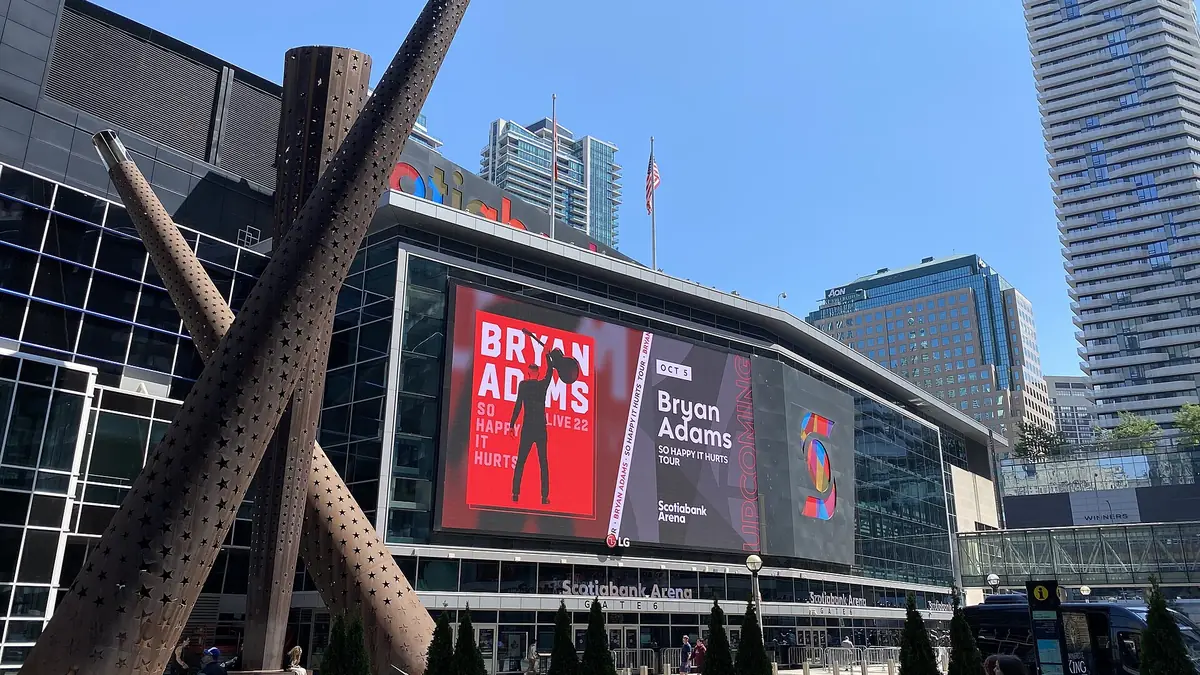
The Toronto Maple Leafs play home games at Scotiabank Arena, 40 Bay Street, directly connected to Union Station, from October through mid-April, with playoff games after that. The arena seats 18,819 for hockey. Leafs tickets are among the hardest in the NHL to find at face value: Toronto is Canada's largest city, and demand for home games stays high through the season.
The franchise began in 1917 as the Toronto Arenas, became the St. Patricks in 1919 and took the Maple Leafs name in 1927 under Conn Smythe. It is one of the Original Six, the six clubs that made up the NHL from 1942 to 1967, and it plays in the Atlantic Division of the Eastern Conference.
- Stanley Cups: 13, second only to Montreal. The Arenas won in 1918, the St. Patricks in 1922 and the Maple Leafs 11 times, from 1932 to 1967.
- The drought: the 1967 title is the club's last, and no NHL team has gone longer without a Cup.
- Rivalries: Montreal (the oldest), Ottawa (the Battle of Ontario), Boston, Buffalo and Detroit.
- Ownership: Maple Leaf Sports and Entertainment (MLSE), which also owns the Raptors.
Choosing seats at Scotiabank Arena for hockey
Scotiabank Arena has two main public seating tiers: the 100 level (the lower bowl) and the 300 level (the upper bowl), with suites, party rooms and premium clubs on the levels between and above. Most lower-level sideline sections run to 28 rows, and for hockey the first row of seats is usually row 3.
Center ice and the benches
TickPick places the Leafs' bench between sections 119 and 120 and the visitors' bench between 118 and 119, which puts section 119 at center ice on the bench side and section 108 at center ice on the penalty-box side. Those two sections are the best full-rink views in the building. Seats directly behind the benches are less ideal than they look, since standing players and staff block the ice.
The end where the Leafs shoot twice
TickPick places the Leafs' attacking net for the first and third periods in front of sections 113 and 114. Seats behind that goal see more Toronto scoring chances. Confirm the end on your listing's seat map before buying, since layouts can change between seasons.
Glass and row height
The rows nearest the ice put you at eye level with the players during warmups and board battles, but the glass distorts the far end of the rink. RateYourSeats calls rows 15 to 25 the ideal height for following play, and TickPick notes glass obstruction in the lowest rows of premium sections.
The 300 level
The upper bowl is the most realistic way into a Leafs game for many fans. TickPick points to the lower rows of sections 308 to 310 and 320 to 322, along the sidelines, as the best value. Upper corners are the seats to skip if you want to see faces rather than jersey numbers.
Leafs schedule shape and the dates that sell first
Each NHL team plays 82 regular-season games, 41 at home. Preseason games come in late September, the regular season runs from early October to mid-April, and the playoffs run from April into June. Saturday home games carry some of the strongest demand of the week, along with holiday-week dates.
- The Montreal Canadiens: the sport's oldest rivalry, between two Original Six clubs, and a reliable sellout.
- The Ottawa Senators: the Battle of Ontario, renewed in a 2025 first-round playoff series that Toronto won.
- The Boston Bruins: Boston eliminated Toronto in the first round in 2018, 2019 and 2024, which keeps every meeting tense.
- Opening night, holiday dates and playoff games: the highest-demand dates on the calendar.
Most listings on this page are resale, so prices float with the opponent, the night of the week and the standings. Weeknight games against Western Conference teams that visit once a season are usually the most attainable tickets.
Game day around Maple Leaf Square
The arena opens onto Maple Leaf Square, a mixed-use development that opened in 2010 with restaurants, a public plaza and large video screens. The plaza holds outdoor viewings of home openers and playoff games on a giant screen, with room for about 5,000 people. The streets around Union Station have plenty of restaurants and bars, which fill early on Saturday nights.
Inside, named bars around the 100 and 300 concourses, including locations near sections 111, 116, 119 and 324, give you a place to meet before puck drop. Visitors from the United States should remember that prices at concessions and in Toronto generally are in Canadian dollars.
Union Station, the PATH and getting inside
Transit is the easy answer. The arena connects directly to Union Station, the hub for TTC Line 1 Yonge–University subway service, GO Transit regional trains, Via Rail and the UP Express from Toronto Pearson International Airport. The underground PATH network also links the arena with much of the downtown core, which helps on cold January nights. Driving downtown on game nights is slow, and parking near the waterfront fills early.
- Arrival: check door times on your ticket; warmups are the best time to watch from the glass.
- Bags and tickets: as of the 2025–26 season, NHL arenas generally use mobile entry and limit bag size. Check the arena's current bag policy before you go.
- Crossing the border: fans driving from Buffalo, Detroit or elsewhere in the US need a passport or other accepted travel document.
Every order is backed by a 100% guarantee. For the official schedule, see the Maple Leafs team site.
From Maple Leaf Gardens to Bay Street
The Leafs played at Maple Leaf Gardens on Carlton Street from 1931 to 1999, and every one of the franchise's 11 Cups under the Maple Leafs name was won while the team called the Gardens home. The 1960s produced four titles in six seasons, the last in 1967, the final season before the NHL expanded from six teams to twelve.
The team moved in February 1999 to the new arena on Bay Street, built around the 1941 Toronto Postal Delivery Building. It opened under an Air Canada naming deal and was renamed Scotiabank Arena on July 1, 2018, under a 20-year agreement. MLSE announced a multi-phase renovation in October 2023 that includes expanded concourses and new concessions. The modern era has brought steady playoff appearances, including second-round runs in 2023 and 2025, and a fan base that keeps waiting for the next one.
Frequently asked questions
Where do the Toronto Maple Leafs play?
The Leafs play at Scotiabank Arena, 40 Bay Street in downtown Toronto, which connects directly to Union Station. The arena opened in February 1999 and took its current name on July 1, 2018.
How many Stanley Cups have the Maple Leafs won?
Thirteen, counting the 1918 Toronto Arenas and 1922 Toronto St. Patricks. The most recent came in 1967.
Which end do the Leafs shoot at twice?
TickPick's seating guide places the Leafs' attacking net for the first and third periods in front of sections 113 and 114. Check the seat map on your listing to confirm.
What is the best way to get to a Leafs game?
Take the TTC subway, GO Transit or the UP Express to Union Station, which connects directly to the arena. The PATH underground network also links the arena to downtown.
What is the capacity of Scotiabank Arena for hockey?
Scotiabank Arena seats 18,819 for hockey, with standing room bringing the total to about 20,270.
Are Leafs tickets hard to get?
Yes. Demand is high every season, and many tickets come through the resale market. Weeknight games against Western Conference opponents are usually the most attainable.