Parking, bag policy, transit and history are on the main The Shrine guide.
Two layouts: standing room or tables
The Shrine does not have a fixed seating chart with numbered sections and rows. It is a club room that runs in two layouts, and the ticket listing tells you which one a show uses.
- General admission: the standard setup. As of the club's fall 2026 calendar, nearly every show on its ticketing partner, StubWire, sells a single General Admission level, standing on the floor in front of the stage. A few add a VIP tier alongside it.
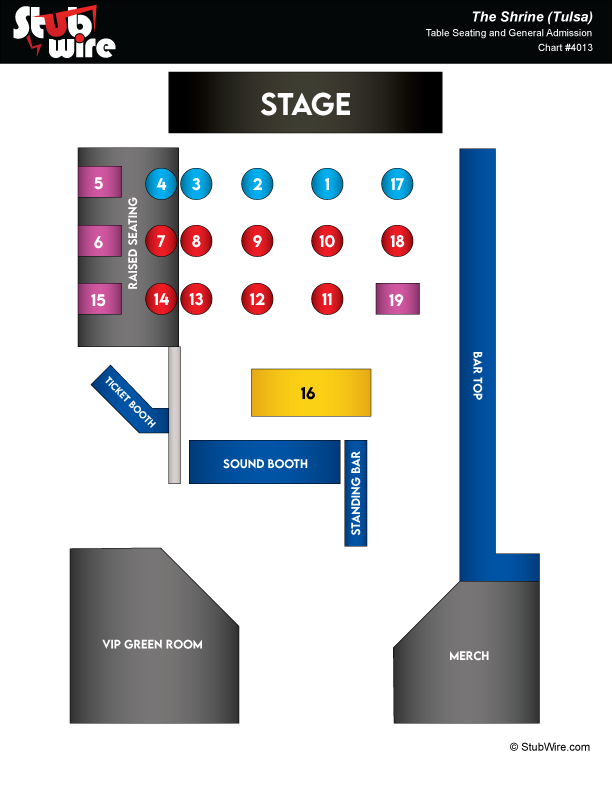
- Table seating and general admission: used for some shows, such as a December 2026 country bill. StubWire's chart for this layout, titled "Table Seating and General Admission," places numbered tables between the stage and the sound booth, with standing room behind and around them.
If a listing shows only general admission, there are no assigned spots; where you stand depends on when you arrive. If it shows table tiers, those tables are the only reserved spots in the room.
The table layout, table by table
StubWire's table chart for The Shrine shows 19 numbered tables. Facing the stage:
- Front row: tables 4, 3, 2, 1 and 17, from left to right, directly in front of the stage. These are the closest seats in the room.
- Second row: tables 7, 8, 9, 10 and 18.
- Third row: tables 14, 13, 12 and 11, with table 19 at the right end.
- Raised seating: tables 5, 6 and 15 sit on a raised platform along the left wall, beside the front rows.
- Table 16: a long table behind the third row, in front of the sound booth.
On a recent table show the club sold Premium 2-Top, 2-Top, 4-Top and 8-Top table seats, with a note that buyers must purchase all the seats at a table, plus general admission standing room. That means a pair needs a two-top and a group of four needs a four-top; a single buyer usually ends up in general admission.
Which tables to want
- Tables 1 to 3: center front, the best view of the performers and the first to sell.
- The raised platform (5, 6 and 15): slightly farther from center, but the height clears the heads of anyone standing, a real advantage once the standing room fills.
- Tables 4 and 17: the front-row ends, close but at an angle to the stage.
- Table 16: the group option, farther back but in a straight line with the stage and the sound booth.
Where to stand at a general admission show
Without tables, the floor in front of the stage is one open standing area. The chart's fixed features still shape the room:
- The bar top runs along the right wall from near the stage toward the back of the room, with a standing bar beside the sound booth. The right side stays busier all night with drink traffic.
- The sound booth sits in the middle of the floor behind the front area. Standing just in front of or beside it puts you where the engineer mixes the show, usually the most balanced sound in the room.
- The front of the stage is the best view and the loudest spot. At punk and metal shows, the center front can become a pit; the left side, near the raised platform, is the calmer edge.
- The back of the room holds the merch area on the right and the green room on the left, with the ticket booth near the entrance on the left side. It is the easiest place to come and go, with the weakest view.
The platform along the left wall is the room's only built-in height. When it is not set with tables, it is the spot to aim for if you are shorter than the crowd.
Table seat or general admission: which to buy
On a show that offers both, the choice comes down to how you want to spend the night.
- Buy a table if you want a guaranteed spot, a place to sit through opening acts and a drink surface in front of you. Tables suit pairs and small groups that can fill a whole two-top, four-top or eight-top, and they suit listening-focused shows where the crowd stays put.
- Buy general admission if you are going alone, if your group size does not match a table, or if you would rather move between the front of the stage, the bar and the sound booth during the night. General admission is also the only option at most shows.
One trade-off is easy to miss. At a table show, the tables take over the floor in front of the stage, so general admission fans stand behind and beside them, farther back than they would at a standing-only show. If being close matters, a front table, not a general admission ticket, is the way to get there.
How tickets and timing work
Shrine tickets are sold through StubWire, the club's ticketing partner, and many shows list a lower advance price and a higher day-of or door price, so buying ahead usually pays. General admission tickets are not tied to a spot, so arrival time matters more than purchase time: on the club's listings, doors open roughly a half hour to an hour before the listed start, and fans who want the stage rail line up before doors.
Table tickets are the scarcest inventory in the room. On table shows, the front tables and the premium two-tops sell first; the larger tables are slower to go because they must be bought as a whole unit. Every show is 21 and over, so bring photo ID even if you hold a table ticket.
Accessibility and questions about the room
The Shrine does not publish accessible seating locations or a room capacity on its website, and StubWire's charts do not mark wheelchair positions. Fans who need an accessible spot, a seat at a general admission show or help reaching a table should call the club at (918) 949-1345 before buying. The tables on the raised platform sit above floor level, so ask before buying one.
Check the Shrine's official site for the show calendar, door times and current policies, and look at the ticket tiers on each listing to see whether a show uses the table layout.
Frequently asked questions
Does The Shrine in Tulsa have assigned seats?
Usually not. Most shows sell only general admission standing room. Some shows use a table layout with 19 numbered tables near the stage, and those table seats are the only assigned spots.
What are the best tables at The Shrine?
Tables 1 to 3 sit center front, directly in front of the stage. Tables 5, 6 and 15 on the raised platform along the left wall are farther from center but see over the standing crowd.
Can I buy a single seat at a Shrine table?
On recent table shows, StubWire required buyers to purchase every seat at a table, sold as 2-top, 4-top and 8-top units. A solo fan usually buys general admission.
Where is the best sound at The Shrine?
Near the sound booth in the middle of the floor, where the engineer mixes the show. The front of the stage is louder and the back of the room is quieter but farther away.
Is there accessible seating at The Shrine?
The club does not publish accessible seating locations. Call The Shrine at (918) 949-1345 before buying to arrange an accessible spot.