.jpg)
Upcoming events at Ambassador Theatre
Dates and live ticket listings appear here as soon as they are on sale. The guide below covers what to know before you buy.
The Long-Time Home of Chicago
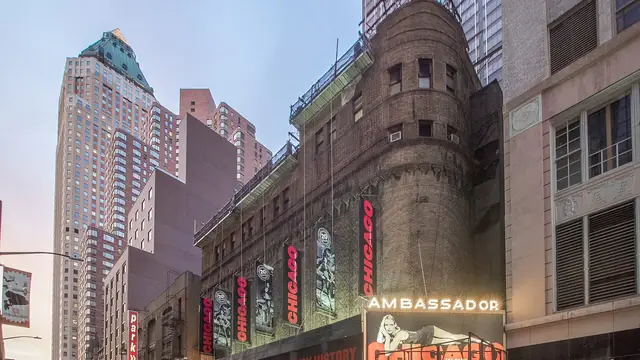
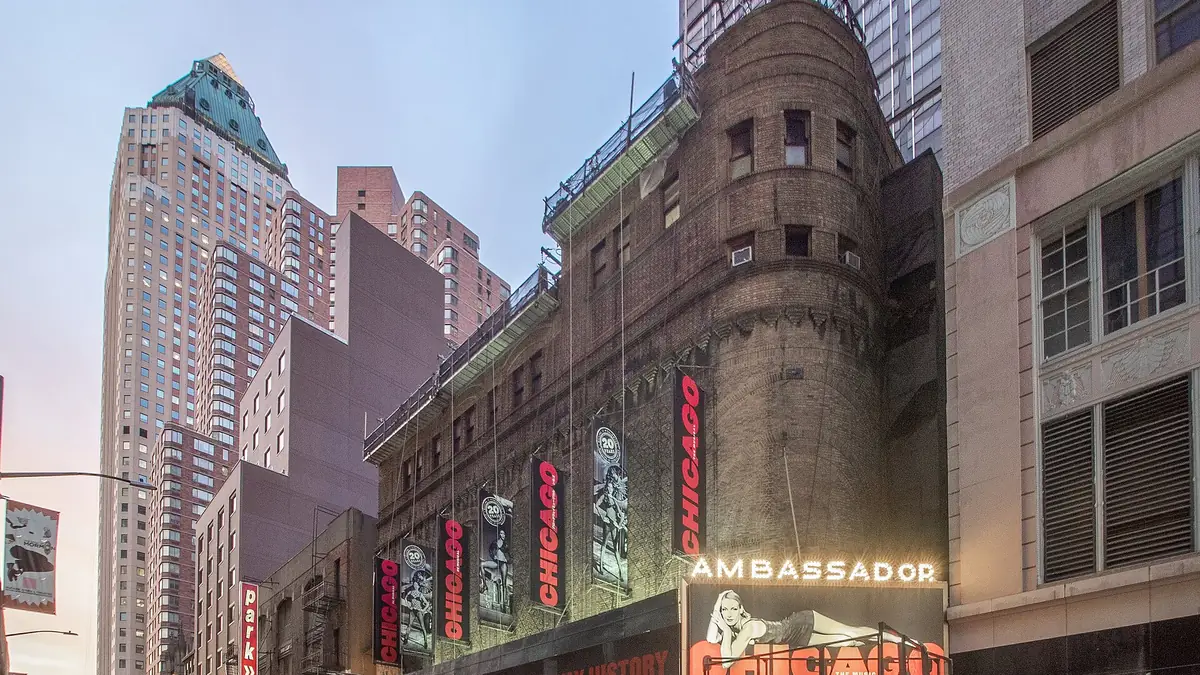
The Ambassador Theatre is a Shubert Organization house at 219 West 49th Street, between Broadway and Eighth Avenue, and it has been the home of the Broadway revival of Chicago the Musical since January 29, 2003. That revival opened at the Richard Rodgers Theatre on November 14, 1996, moved to the Shubert Theatre in 1997, and settled at the Ambassador six years later. As of 2026 it is the longest-running show currently on Broadway, the longest-running musical revival and the longest-running American musical in Broadway history, with more than 11,000 performances.
The theater seats about 1,100. Shubert's own seating breakdown lists 573 orchestra seats, 264 front mezzanine seats, 250 rear mezzanine seats and 8 box seats, plus 19 standing-room spots, for a total of 1,114. The Broadway League figure cited by Wikipedia is 1,125, and Wikipedia notes that 41 of the orchestra seats are in the pit area. Long-running shows do not last forever, so confirm current performances in the listings on this page.
A Diagonal Auditorium on a Square Lot
The Ambassador's quirk is its geometry. Architect Herbert J. Krapp placed the auditorium diagonally on a lot of roughly 100 by 100 feet, because a diagonal plan could fit about 1,300 seats where a conventional parallel plan would have held only about 900. From the street the building looks ordinary; inside, the stage sits across one corner of the square and the seating fans out toward the opposite corner, with strongly curved side walls.
- Orchestra (the ground-floor seating) is step-free from the lobby and holds about half the house.
- Front mezzanine is the forward part of the single upper level. Wikipedia calls this level the balcony; Shubert's ticketing calls it the mezzanine.
- Rear mezzanine is the back part of the same level, with roughly as many seats as the front.
- Boxes flank the stage, just 8 seats in all.
The proscenium (the arch framing the stage) is about 45 feet wide and 25 feet high, a modest size that keeps most of the house reasonably close to the action.
The Best Seats for Chicago, and the Trade-Offs
Chicago is a lean, presentational staging built on Bob Fosse-style choreography, so seeing bodies and lines clearly matters more than seeing scenery. That shapes the seat choice.
- Center orchestra, about rows E through M, is the strongest all-around choice: close enough for facial expression, far enough back to take in the full width of the dance.
- Front center mezzanine is a close second and many repeat visitors prefer it, because the higher angle shows the choreography's patterns.
- Front orchestra rows are thrilling for some and tiring for others; you look up at the stage and lose the depth of the stage picture.
- Far-side seats are where the diagonal layout bites. The curved walls push the outer seats around toward the stage, and from the extreme sides the near edge of the stage can be cut off.
- Rear orchestra sits under the mezzanine overhang (the underside of the upper level), which can make the sound feel boxed in.
- Rear mezzanine is the usual value option: complete but distant, and best near the center.
Because the show is a long-running hit rather than a new opening, demand is steadier than for most musicals. Holiday weeks, Saturday nights and weeks when a celebrity guest star is in the cast tend to sell fastest; weeknight performances outside the holidays usually offer the most choice.
Accessible Seating and Services
The orchestra is the accessible level. According to the Shubert Organization, all parts of the orchestra are reachable without steps, while the mezzanine requires climbing two flights of stairs, 38 steps in total.
- Seven wheelchair locations are in the orchestra only, each paired with companion seating.
- Eleven aisle seats have folding armrests for easier transfer; the Theatre Development Fund guide counts six in the orchestra and five in the mezzanine.
- The main entrance has two small steps; the side entrance is step-free.
- An ADA unisex restroom is next to the ticket lobby.
- Infrared assistive listening devices, audio description and captioning are available, and the GalaPro app offers captioning.
Shubert Audience Services handles accessible bookings and requests; details are on the Shubert Organization's Ambassador page. Security screening and bag rules are set by the theater and can change, so check the current policy before you go.
Getting to West 49th Street
The Theatre Development Fund recommends taking the 1, C or E to 50th Street, walking south to 49th Street and then east to the theater. The Times Square-42nd Street station is a longer walk but connects nearly every line in Manhattan. Buses serving the block include the M7, M20 and M104 on the avenues and the M50 crosstown.
West 49th Street fills quickly in the half hour before curtain, and the sidewalk gets crowded when several nearby houses let out at once. Arrive 30 minutes early to clear security and find your seat without rushing, and plan to walk a block or two before hailing a cab or rideshare after the show.
Radio Studio, Movie House, Broadway Again
The Shubert brothers built the Ambassador in 1921, one of four theaters they put up on 48th and 49th Streets in a burst of expansion after World War I. It opened on February 11, 1921, with the operetta The Rose Girl, and early hits included Blossom Time (516 performances). The facade is plain gold-beige brick, a sign of post-war economy; the interior carries Adam-style detailing.
The Shuberts sold the property in 1935, and over the next two decades it served as a CBS broadcast studio, a film house and a studio for the DuMont Television Network. The Shuberts took it back in 1956 and restored it to live theater. Later runs included Godspell (1976), Bob Fosse's Dancin' (1980 to 1982) and Bring in 'da Noise, Bring in 'da Funk (1,130 performances). The Landmarks Preservation Commission designated the interior a New York City landmark in August 1985; the exterior designation was not upheld.
The show paused with the rest of Broadway on March 12, 2020, and resumed at the Ambassador on September 14, 2021.
Frequently asked questions
What show plays at the Ambassador Theatre?
The Broadway revival of Chicago has played the Ambassador since January 29, 2003. Check the listings on this page for current performance dates.
How many seats are in the Ambassador Theatre?
Shubert lists 573 orchestra, 264 front mezzanine, 250 rear mezzanine and 8 box seats plus 19 standing-room spots, totaling 1,114. The Broadway League figure is 1,125.
Are there bad seats at the Ambassador Theatre?
The far-side seats are the weakest because the diagonal auditorium angles them toward the stage, and the rear orchestra sits under the mezzanine overhang. Center seats on either level are the safer buy.
Is the Ambassador Theatre wheelchair accessible?
The orchestra is reachable without steps through the side entrance and has seven wheelchair locations with companion seats. The mezzanine is 38 steps up with no elevator.
What is the nearest subway to the Ambassador Theatre?
Take the 1, C or E to 50th Street, then walk south to 49th Street and east toward Broadway.