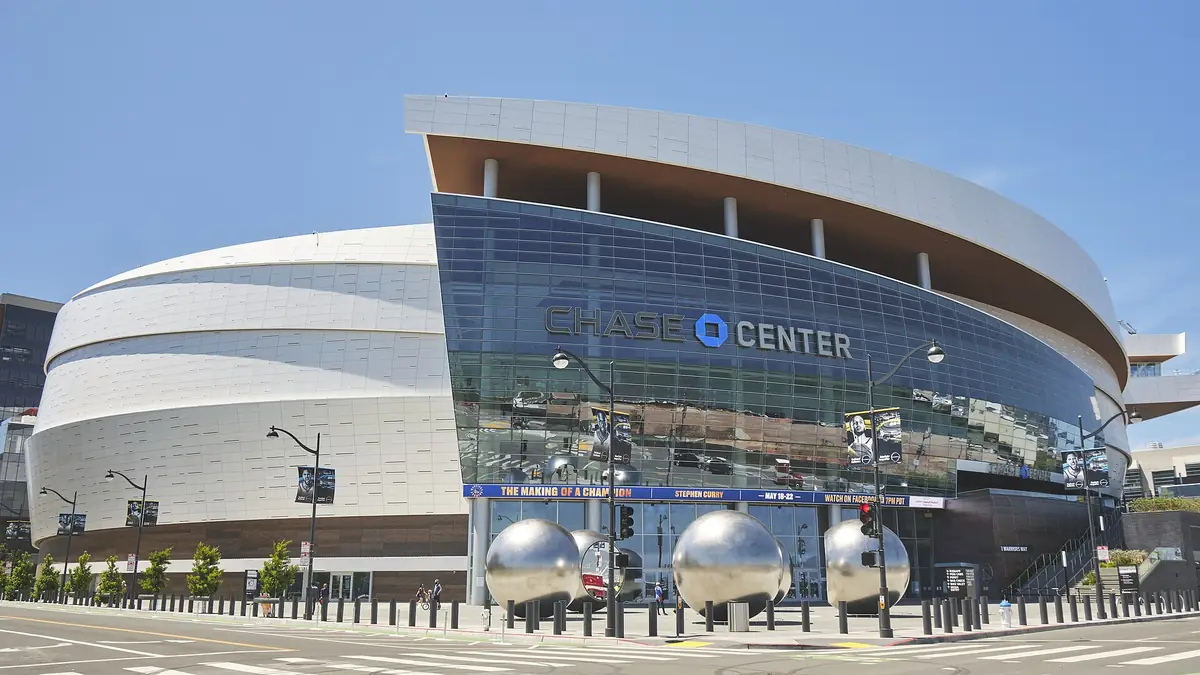

Looking for section numbers and the best seats by level? See the Chase Center Seating Chart.
Upcoming events at Chase Center
Dates and live ticket listings appear here as soon as they are on sale. The guide below covers what to know before you buy.
What Chase Center is and who plays there
Chase Center is an indoor arena in San Francisco's Mission Bay neighborhood that seats 18,064 for basketball and about 19,500 for concerts. It opened on September 6, 2019, as the new home of the Golden State Warriors, who moved across the bay after 48 years in Oakland. The building was privately financed and designed by MANICA Architecture, with interiors by Gensler.
The arena has three main tenants and a busy concert calendar:
- Golden State Warriors (NBA): the regular season runs from October into April, with playoffs after that.
- Golden State Valkyries (WNBA): the expansion team began play in 2025, and fans call the building Ballhalla on Valkyries nights. The WNBA season runs through the summer.
- San Francisco Dons: the university's basketball teams play selected games here.
Between seasons, the arena books major concert tours, comedy, wrestling and college basketball events. It hosted the 2025 NBA All-Star Game and is scheduled to host the 2027 WNBA All-Star Game.
How the Chase Center seating bowl is organized
Chase Center is a two-ring bowl with premium seating packed between and below the rings. The numbering works like this:
- Courtside and low premium sections: the seats closest to the floor carry single- and double-digit section numbers, separate from the main bowl numbering.
- The 100 level (sections 101–124): the lower bowl, wrapping the court.
- Suites and theater boxes: the arena lists 136 suites, including 44 set between the two levels, plus 32 courtside lounges and 60 theater boxes (small premium boxes) along the sidelines.
- The 200 level (sections 201–225): the upper bowl.
Within a section, seat 1 is on the right side as you face the floor, and the numbers increase to the left. That helps when comparing two listings in the same row: lower seat numbers sit closer to the section's right-hand aisle.
Best seats for basketball and concerts, and where value sits
For Warriors and Valkyries games
Sideline sections in the 100 level give the classic view, and center-court sections draw the heaviest demand. For value, the first rows of the 200 level along the sidelines are the pick: the upper bowl is steep and sits close to the court, so the front of the 200s sees the full floor and both baskets without the heads-in-the-way problem of the deep 100-level rows. Seating guides note that the club and theater levels between the rings offer the flattest, most direct viewing angle in the building, at a premium.
Behind the baskets, lower 100-level baseline seats are good for watching plays develop toward you but poor for judging the far end of the court. Corner sections are a compromise that usually carries less demand than the sideline.
For concerts
In an end-stage setup, the 100-level sections along the sides closest to the stage are the most consistent choice; the floor puts you closest but is flat, so shorter fans in the back half of the floor see screens more than the stage. Sections directly behind the stage are typically closed or sold as limited-view, so read the listing notes carefully.
Seats to think twice about
- The last rows of the 200-level corners, which are the farthest from the court in the building.
- Low baseline rows if you care about seeing the whole floor.
- Side-stage concert seats without a clear view note in the listing.
Getting to Mission Bay: Muni, Caltrain, ferry and parking
Transit is the easiest way in, and the arena is built around it. As of the 2025–26 season:
- Muni Metro: the T Third Street line stops at UCSF/Chase Center, steps from the arena, and the Central Subway connects it to downtown. A Chase Center event ticket serves as Muni fare on event days.
- BART: ride to a Market Street station and transfer to Muni.
- Caltrain: the 4th and King station is about a 15- to 20-minute walk.
- Ferry: for Warriors home games, ferries serve the Mission Bay Interim Ferry Landing at Pier 48 1/2.
- Bike valet: a free valet holds up to 300 bikes on 16th Street.
- Driving: the arena's own garage and nearby lots fill on big nights; book ahead through the arena's app or a parking service.
- Rideshare: pickups run along Terry A. Francois Boulevard and 16th Street, and surge pricing after a sellout is common.
Check the arena's A to Z guide for current transit and parking details before you go.
Bag policy, doors and entry rules
As of the 2025–26 season, bags may be no larger than 14 by 14 by 6 inches. Backpacks are not allowed, except single-compartment drawstring bags within that size. Oversized bags can be checked for a fee near 16th Street and Terry A. Francois Boulevard.
- Doors: typically 90 to 120 minutes before a Warriors tipoff; concert times vary by tour.
- Re-entry: not permitted.
- Smoking and vaping: prohibited anywhere on the property.
- Prohibited items: outside bottles and cans, selfie sticks, professional recording equipment and noisemakers, among others.
Policies change, so check the venue's current policy before you go. Every order through this site includes free shipping and a 100% guarantee.
Food, Thrive City and the neighborhood
The arena sits in a waterfront district rather than a parking lot. Thrive City, the open plaza outside the arena, hosts restaurants, markets and community events year-round. Arriving early and eating on the plaza is one way to avoid the busiest concourse lines just before tipoff.
From Oakland to Mission Bay
The Warriors played at Oracle Arena in Oakland for 48 years before opening Chase Center in 2019. The privately funded arena, which cost about 1.4 billion to build, was planned as a year-round venue with its own plaza and transit links rather than a basketball-only building. The 2023 opening of the Central Subway tied the arena more closely to downtown. Since then, the arrival of the Valkyries in 2025 and the 2025 NBA All-Star Game have kept the building busy through the year.
Frequently asked questions
How many people does Chase Center hold?
Chase Center seats 18,064 for basketball and about 19,500 for concerts.
Who plays at Chase Center?
The Golden State Warriors (NBA) and the Golden State Valkyries (WNBA) play their home games here, and the San Francisco Dons play selected games. The arena also hosts major concert tours.
What is the bag policy at Chase Center?
As of the 2025–26 season, bags must be no larger than 14 by 14 by 6 inches, and backpacks are not allowed except single-compartment drawstring bags. Check the arena's current policy before you go.
Is the 200 level at Chase Center a good place to sit?
Often, yes. The upper bowl is steep and close to the court, so the front rows of the sideline 200s see the whole floor and are a common value choice for basketball.
How do you get to Chase Center on public transit?
The Muni T Third Street line stops at UCSF/Chase Center next to the arena, and an event ticket serves as Muni fare on event days. Caltrain's 4th and King station is about a 15- to 20-minute walk, and ferries run to Pier 48 1/2 for Warriors games.