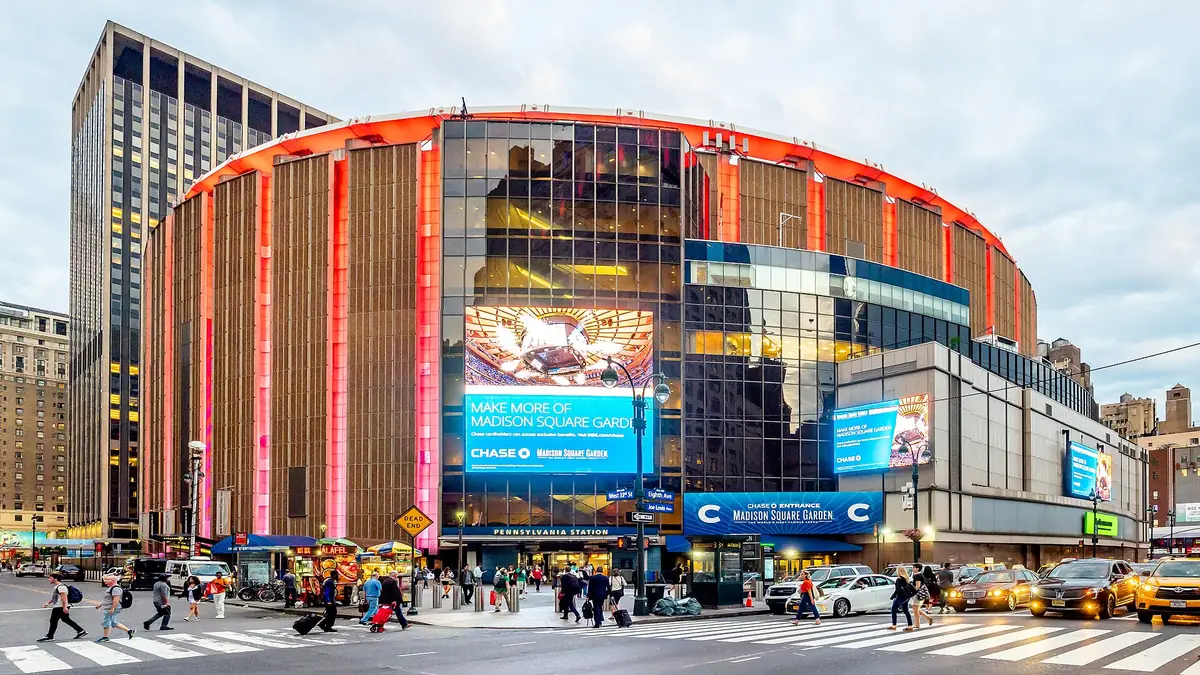
_-_Full_(48124330357).jpg)
Parking, bag policy, transit and history are on the main Madison Square Garden guide.
How the Garden's seat map reads
For most buyers, the best value on the Madison Square Garden seating chart is the front rows of a center-court section in the 200 level. The premium choice is the sideline 100s, and two seating guides agree that sections 106–108 and 116–118 are the center-court (or center-ice) sections on the two long sides. Everything else on the map is a trade between distance and angle.
The Garden is round rather than oval, so the seat map reads as stacked rings instead of long sidelines with deep end zones. From the floor up, the tiers are:
- The floor: courtside seats for basketball, glass seats for hockey, and floor sections for concerts.
- The 100 level: the lower bowl, sections numbered in the 100s, with club seating in the front rows at midcourt.
- The 200 level: the upper bowl, the largest tier, with section numbers running up to 227.
- The Chase Bridges: two walkways suspended from the ceiling, sold as 300-numbered sections.
- The Blue Seats: 400-numbered sections set high on the sides; two sources agree they are sections 413–421, with seven rows each.
Because the round shape keeps the corners close to the floor, a corner seat here gives up less than it does in an oval arena. The first digit of the section number still tells you most of what you need to know about height.
The 100 level and the floor
The lower bowl is the most expensive public tier, and the sideline sections 106–108 and 116–118 carry the steepest prices within it. Club seats occupy the front rows at midcourt, and premium floor-level rows sit in front of some sections, so the row numbers on a listing do not always start at the floor. If a listing shows a lettered row or a premium row label, ask the seller or check the map to see how many rows sit in front of it.
Sideline versus baseline
Sideline seats show the whole floor at a flat angle and feel closest to the players. Seats in the corners give a diagonal view of both ends and usually cost noticeably less. The weakest lower-bowl seats are the low rows behind each basket: the stanchion and backboard sit in the sightline, and the far end of the court loses depth.
Row height matters more than section
A middle row in a corner section often beats a front row behind the basket. For basketball, the first several rows put you at eye level with the people standing along the sideline. For hockey, the lowest rows sit behind the boards and glass, which hide the near side of the ice. Rows in the middle of the section are the better pick for both sports if you want to follow the whole game rather than one end.
The 200 level: where most fans sit
The 200 level holds a large share of the Garden's seats and most of its moderately priced inventory. The 2011–2013 renovation rebuilt this tier, and seating guides credit the work with improving its sightlines.
- Front rows, center court: the best value in the building. The view is high enough to show spacing, defensive rotations and line changes, and the center-hung scoreboard sits close to eye level.
- Corners: a good diagonal view that suits hockey, where rushes come toward you.
- Ends: fine for hockey, weaker for basketball, where the far basket feels distant.
- Back rows: high. They show the whole floor but little detail of the players, and fans uneasy with heights should favor the front half of the section.
Fan reviews of some 200-level seats note that the suspended bridges and hanging equipment can cut off part of the video screens. The court or ice stays visible; you lose some of the replay board.
The Chase Bridges and the Blue Seats
The two Chase Bridges were added during the renovation and hang roughly 94 feet above the floor. Their seats look almost straight down on the action. The view is unusual and fun once, but it flattens the game into a diagram, and seating guides note that some seats behind the front row lose part of the scoreboard to the structure. Two seating guides list different section numbers for the bridges, so rely on the map attached to your listing rather than a number you read elsewhere.
The Blue Seats are the short, high sections on the sides of the building, numbered 413–421 with seven rows each, according to two seating guides. They have a long reputation as the loudest seats in the Garden. One guide advises avoiding the back rows (rows 5–7) because of possible obstructions, so a front-row Blue Seat is the safer buy.
Both areas are best treated as an experience rather than a view. A fan who wants to follow the game closely should pick the front half of the 200 level instead.
Knicks, Rangers and fight configurations
The same bowl seats 19,812 for basketball and 18,006 for hockey. The rink takes more floor space than a court, so the lowest rows and the courtside seats change from one sport to the other.
Basketball
Courtside rows line the floor, and the sideline 100s at midcourt are the premium buy. Seating guides publish conflicting bench locations for the Knicks and the visitors, so do not pay extra for a bench side unless the seat map on your listing shows it.
Hockey
Hockey rewards height. The middle rows of the sideline 100s and the front of the 200 level show passing lanes and line changes far better than the glass seats, which deliver the speed and sound of the game but hide plays at the far boards. Guides also disagree on which end the Rangers attack twice, so treat any shoot-twice claim as unconfirmed unless the listing's map marks it.
Boxing and other floor events
For boxing, MMA and similar events, the ring sits in the middle of the floor with seating around it, so every side becomes a sideline. The lower rows of the 200 level often give a clearer view of the ring than mid-floor seats, which are flat.
End-stage and center-stage concerts
Most concert tours use an end stage at one end of the floor. That one choice changes the whole map:
- Behind the stage: sections directly behind the stage are either closed or sold as limited view. Buy them only when the listing describes the sightline.
- Side sections near the stage: the best mix of proximity and sightline in the lower bowl, though the closest seats view the stage at a sharp angle.
- The floor: general admission or reserved, depending on the tour. The floor is flat, so anyone shorter than average beyond the first several rows watches over heads.
- The 200 level facing the stage: distant but straight on, which suits shows with large video or lighting production.
For a center-stage or in-the-round show, there is no back of the house. Every side becomes a front, the lower rows of the 200 level gain value, and the floor becomes the premium. Stage layouts vary by tour, so check the map on your listing for the exact setup.
Accessible seating and choosing an aisle
Wheelchair-accessible positions appear on resale listings with a WC tag in the section or row name. The Garden's own FAQ addresses accessible seating and directs guests to the event detail page on the Madison Square Garden site, where current options for each event are listed. Contact the venue before you buy if you need a specific location, an elevator route or companion seats.
Aisle seats are worth a small premium in the 200 level, where rows are long and steep and a trip to the concourse means passing a dozen people. Families with young children and anyone who expects to leave the seat often should ask for an aisle; seat-numbering direction is not consistent across seating guides, so use the map on the listing to see which seat numbers sit on the aisle. Every GoodSeats order is backed by a 100% guarantee.
Frequently asked questions
What are the best seats at Madison Square Garden?
For the view, the sideline 100s; two seating guides identify the center sections as 106–108 and 116–118. For value, the front rows of a center-court 200-level section show the whole floor at a broadcast-style angle.
How many rows are in each section at Madison Square Garden?
Row counts vary by tier. Two seating guides agree the Blue Seats (sections 413–421) have seven rows, while the 100 and 200 levels are much deeper. Premium rows sit in front of some lower-bowl sections, so row 1 is not always the first row.
Are there obstructed views at Madison Square Garden?
Some seats lose part of the video board to the Chase Bridges or hanging equipment, and one guide advises avoiding the back rows of the Blue Seats. At concerts, sections behind the stage are sold as limited view or closed.
Are the Chase Bridge seats worth it?
They are a memorable once-in-a-while view, hung roughly 94 feet above the floor and looking almost straight down. The front half of the 200 level shows the game more completely.
Does Madison Square Garden have club seating?
Yes. Club seats occupy the front rows of the lower bowl at midcourt, and premium lounges such as the Delta Sky360 Club and The Loft are tied to specific ticket types. Check the listing for what access is included.
Where is accessible seating at Madison Square Garden?
Wheelchair positions appear on listings with a WC tag. The Garden directs guests to each event's page on its site for accessible options, so contact the venue if you need a particular location or companion seats.