.jpg)
Looking for section numbers and the best seats by level? See the Radio City Music Hall Seating Chart.
Upcoming events at Radio City Music Hall
Dates and live ticket listings appear here as soon as they are on sale. The guide below covers what to know before you buy.
The Showplace of Rockefeller Center
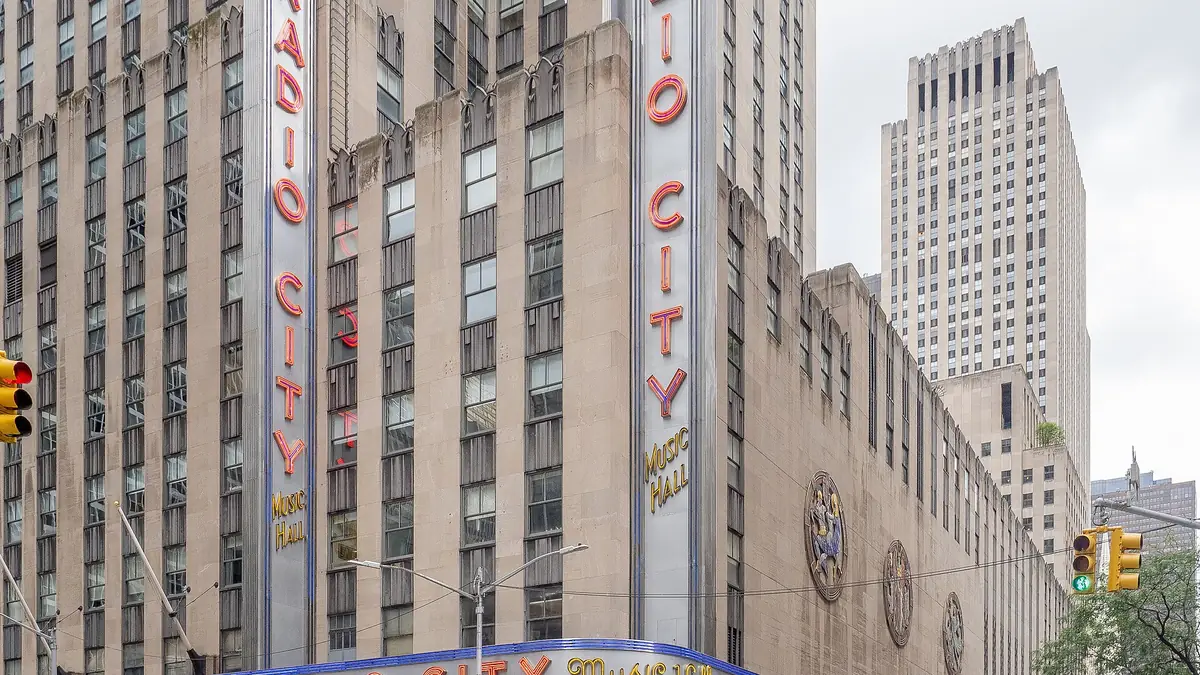
Radio City Music Hall is the 5,960-seat Art Deco theater at 1260 Avenue of the Americas (Sixth Avenue) in Rockefeller Center, opened on December 27, 1932. It hosts concerts, comedy, award shows and, every holiday season, the Christmas Spectacular starring the Radio City Rockettes. If you want the quick answer on seats: the front rows of the first mezzanine, center, give the best overall view of the stage, and the center orchestra from mid-house back is the pick for concerts where closeness to the performer matters most.
The building is owned by Tishman Speyer and operated by Madison Square Garden Entertainment. It is a New York City landmark inside and out, and it is part of the Rockefeller Center National Historic Landmark designated in 1987.
Orchestra and Three Mezzanines, Explained
The auditorium is an oval that fans out toward a proscenium arch (the frame around the stage opening) more than 60 feet high and 100 feet wide, designed to resemble a setting sun. Seating breaks down into four levels:
- Orchestra (the ground floor): about 3,500 seats, more than half the house, on a gently raked floor.
- First Mezzanine: the lowest balcony, reached on the sides by ramps that rise from the stage, which makes the stage seem to wrap the orchestra.
- Second Mezzanine: the middle balcony, with a clear look down at the full stage.
- Third Mezzanine: the highest level, farthest from the stage but still facing it squarely.
The three mezzanines are deliberately shallow, which is why sightlines hold up well even at the top. Sections run left, center and right on each level. Seating guides note that lower seat numbers sit toward the right side of a section when you face the stage, so check the seat map if you want an aisle.
Where to Sit for Each Kind of Show
The Christmas Spectacular
The Rockettes' kick line and formations are designed to be seen whole. The front of the first and second mezzanines, center, shows the patterns and the full stage at once. The show's own seat guide points to the orchestra for an up-close look and to the upper mezzanines for the choreography and the overhead projections. Very front orchestra rows put you close but looking up at the stage, and you can miss the geometry that defines the show.
Concerts and comedy
For a solo artist or comedian, distance matters more than spectacle. Center orchestra seats from roughly the middle of the house forward are the best choice. The first mezzanine center is next, and it often costs less than prime orchestra.
Award shows and televised events
Televised nights reserve large blocks for production and guests, and camera positions can interrupt a view. Buy only listings that describe the seat location clearly.
Seats to Think Twice About
- Rear orchestra under the overhang. The mezzanines extend over the back of the orchestra. Seats deep underneath feel enclosed and can cut off the top of the proscenium and overhead effects, which matters most at the Christmas Spectacular.
- Far side sections. The stage is 144 feet wide, so extreme side seats on any level look across the stage at an angle. Center sections on a higher level usually beat side sections on a lower one.
- Seats near the sound booth. Seating guides flag a few rear orchestra seats near the mixing position as partly obstructed.
- The very top of the third mezzanine is far from the stage. It works for a spectacle but less well for a quiet acoustic set.
Because the mezzanines are shallow, a bad seat here is usually a far seat rather than a blocked one. Every GoodSeats order is backed by a 100% guarantee.
The Christmas Spectacular Season
The Christmas Spectacular first played the Music Hall in 1933 and has drawn more than 73 million people since. The 2026 engagement is scheduled for November 4, 2026, through January 4, 2027, with 230 performances, the most in the show's history, and it adds one new scene.
Demand follows the calendar. Weekday morning and early afternoon shows in early November are usually the easiest to buy. Weekends, the Thanksgiving holiday, and the weeks between mid-December and New Year's Day draw the heaviest demand, and resale prices rise as those dates approach. Families who can be flexible get the widest choice of seats by picking a weekday in the first half of the run. Dates and showtimes are posted on the Rockettes' seating and schedule pages.
Getting There and Getting In
The 47th–50th Streets–Rockefeller Center subway station, served by the B, D, F and M trains, is next to the building. Parking in Midtown is costly and slow; the venue points drivers to SpotHero for reserving a nearby garage.
There are three ways in: on 50th Street east of Sixth Avenue, on 51st Street east of Sixth Avenue, and through the Box Office Lobby on Sixth Avenue between 50th and 51st Streets, which is the accessible entrance. As of fall 2026, posted rules include these, but check the venue's current policy before you go:
- Bags need not be clear but must fit under your seat; anything larger than 22 by 14 by 9 inches is refused, and all bags are x-rayed.
- There is no bag or coat check, which matters in December.
- Tickets are digital, displayed on your phone; phone-free events use locked pouches and printed tickets.
- No re-entry once you exit.
- Children under 2 may sit on a lap at most events, but some family shows require a ticket for anyone over 1.
Current policies are on the Radio City FAQ page.
From Movie Palace to Concert Hall
Radio City was built as part of the Rockefeller Center project, with theater impresario Samuel "Roxy" Rothafel shaping its oval auditorium. Edward Durell Stone designed the exterior and Donald Deskey the interiors, including the 165-foot Grand Foyer with its long Caldwell chandeliers. The stage machinery was advanced for its day: a 50-foot turntable, three 70-foot elevator sections and an orchestra pit on a hydraulic lift.
Two weeks after opening, the hall switched to a format of first-run films paired with a stage show, and it premiered films from King Kong to The Lion King. Facing closure in 1978, it was saved through landmark designation, and the film-and-stage format ended in 1979 as the hall turned to concerts. A 1999 restoration replaced the seats and restored the ceiling and curtain. The Grammys, the Tony Awards and the NFL Draft have all been staged here.
Frequently asked questions
How many seats does Radio City Music Hall have?
Radio City seats 5,960. About 3,500 seats are in the orchestra, and the rest are spread across three shallow mezzanines.
Is the orchestra or mezzanine better at Radio City?
For the Christmas Spectacular, the front of the first and second mezzanines, center, shows the Rockettes' formations and the full stage best. For concerts and comedy, center orchestra seats are the better choice.
When does the Christmas Spectacular run?
The 2026 season is scheduled from November 4, 2026, through January 4, 2027, with 230 performances. Weekdays early in the run usually have the widest seat selection.
What is the bag policy at Radio City Music Hall?
As of fall 2026, bags need not be clear but cannot exceed 22 by 14 by 9 inches and must fit under your seat. There is no bag or coat check, so confirm the current rules before you go.
Which entrance should I use at Radio City?
Entrances are on 50th Street and 51st Street just east of Sixth Avenue, plus the Box Office Lobby on Sixth Avenue between 50th and 51st, which is the accessible entrance.
What subway goes to Radio City Music Hall?
The B, D, F and M trains stop at 47th–50th Streets–Rockefeller Center, beside the building.