.jpg)
Upcoming events at Apollo Theater
Dates and live ticket listings appear here as soon as they are on sale. The guide below covers what to know before you buy.
Harlem's Stage, Mid-Renovation
The Apollo Theater is a roughly 1,500-seat theater at 253 West 125th Street in Harlem, run by the nonprofit Apollo Theater Foundation. It presents music, comedy and dance, and it is best known for Amateur Night, the audience-judged talent contest it has staged since 1934. As of October 2026, the historic theater is closed for the largest renovation in its history, and Apollo programming runs a few doors east on the same block at The Apollo Stages at the Victoria (233 West 125th Street, third floor).
The Apollo has said it anticipates reopening the historic house beginning in late 2026, with a public opening in spring 2027. Read the venue line on any ticket carefully: an Apollo-presented show in late 2026 may be in a 199-seat or 99-seat room at the Victoria, not the 1,500-seat main hall.
- Historic theater: the main auditorium, with an orchestra and two balcony levels.
- Apollo Stages at the Victoria: the 199-seat Theater 1 and the 99-seat Jonelle Procope Theater, opened in 2024 inside the restored 1917 Victoria Theater.
- Soundstage: a smaller Apollo space used for intimate programming.
How the Historic House and the Victoria Rooms Are Laid Out
The historic auditorium is a rectangle with curved side walls and a domed ceiling. Seating is stacked on three levels: the orchestra (the ground-floor seats facing the stage), and two balcony levels above it, often labeled the mezzanine (the lower balcony) and the balcony (the upper one). By today's standards it is a compact house: the room once held about 2,000 people in the 1930s, about 1,700 in the 1970s, and about 1,500 now.
The renovation changes the balance between levels. The Apollo's published plan adds 29 seats to the orchestra and removes the same number from the balcony and mezzanine, so total capacity stays roughly the same while more people sit on the ground floor. Every orchestra seat is new; the upper-level seats are refurbished rather than replaced.
The Victoria rooms work differently. At 199 and 99 seats, there is no meaningful far seat; the trade-off is that small rooms sell out fast and leave little resale inventory for popular nights.
Best Seats for Concerts, Comedy and Amateur Night
Concerts and headliners
For a singer or band, the center orchestra from the middle rows back gives the most balanced sound and a clear view of the full stage. The front few rows are the most intimate seats in the house but put you below stage level and looking up, which matters less for a solo voice than for a dance-heavy show.
Comedy and talk events
Comedy rewards being close. Orchestra seats anywhere in the center third, or the front of the lower balcony, keep facial expressions readable. Side seats on the far left or right of the orchestra are the ones to skip for a stand-up set; you see a profile for an hour.
Amateur Night
Amateur Night is built around the crowd: the audience judges each act and votes for the winner. The lower balcony is a strong choice here because you see the stage and the whole reacting crowd at once. The upper balcony is the value tier, but it puts you farthest from the stage in a tall room, so pick the front rows of that level if you buy there.
Seats to think twice about
- Rear orchestra under the balcony overhang: the overhanging level above can cut off the top of the stage picture and flatten the sound.
- Extreme side seats: in a rectangular hall with curved walls, the far sides angle you across the stage.
- Back rows of the top balcony: fine for the energy, weak for detail.
Amateur Night and How to Plan Around It
Amateur Night began in 1934 as a Wednesday-night contest under manager Morris Sussman. Early winners included Ella Fitzgerald and Pearl Bailey in the 1930s and Sarah Vaughan and Ruth Brown in the 1940s, and the Apollo lists Billie Holiday, Sammy Davis Jr., James Brown, Gladys Knight, Luther Vandross, D'Angelo and Lauryn Hill among the artists whose careers started on its stage. The show reached a national television audience through Showtime at the Apollo, launched in 1987.
In 2026, Amateur Night runs at the Apollo Stages at the Victoria while the main theater is closed. The Apollo bills it as family-friendly with all ages welcome. Because the interim room is a fraction of the historic hall's size, each date has far fewer seats, so buy early for a specific night rather than waiting for late resale.
- Demand drivers: weekends and holiday weeks.
- Easier nights: regular weeknight shows early in a season.
- Reopening year: expect strong demand when Amateur Night and headliners return to the renovated main stage.
Getting to 125th Street
The subway is the practical way in. The A, B, C and D trains stop at 125th Street and St. Nicholas Avenue, about a block west of the theater; the Victoria is a few doors east of the historic entrance on the same block. Several MTA bus routes run along 125th Street, Harlem's main commercial street.
Driving is a poor choice for most visitors. Street parking on 125th Street is scarce at show time, and garages in the area fill on weekend nights. If you take a cab or rideshare, ask to be dropped on 125th Street between Seventh and Eighth Avenues (Adam Clayton Powell Jr. and Frederick Douglass Boulevards) and allow extra time on busy evenings.
Plan dinner on the corridor. The blocks around the Apollo have restaurants within walking distance, and arriving early lets you see the Apollo Walk of Fame plaques outside the theater, dedicated in 2010.
Entry, Bags and Accessibility
As of October 2026, the Apollo's visitor page says all persons and bags are subject to search, bags must fit comfortably under your seat, and oversized bags are prohibited. Tripods and professional camera equipment are not allowed, and outside food and drink are banned, with accommodations for medical needs. Check the venue's current policy before you go, since rules may change when the historic theater reopens.
- Wheelchair seating: available on request through the box office.
- Restrooms at the Victoria: one men's, one women's and one single-use gender-neutral restroom, all ADA-compliant, per the venue.
- Service animals: service dogs are permitted; therapy dogs are not.
- Elevators and restrooms in the historic house: both are being modernized in the renovation.
Every order is backed by a 100% guarantee. For the current calendar, box office hours and accessibility contacts, see the Apollo's visitor information.
From Burlesque House to Harlem Landmark
The building opened in 1914 as Hurtig & Seamon's New Theatre, a burlesque house designed by George Keister in a neoclassical style. On January 26, 1934, it reopened as the 125th Street Apollo Theatre, serving Black performers and audiences. Frank Schiffman and Leo Brecher took over in 1935; Percy Sutton and a group of investors bought it in 1981. The theater became a New York City landmark and was added to the National Register of Historic Places in 1983, and nonprofit management followed in the early 1990s.
Its recorded legacy is just as large. James Brown cut Live at the Apollo there in October 1962; the album was added to the Library of Congress National Recording Registry in 2004. A first restoration phase in the early 2000s redid the facade, stage and dressing rooms, and an LED marquee modeled on the original went up in 2005.
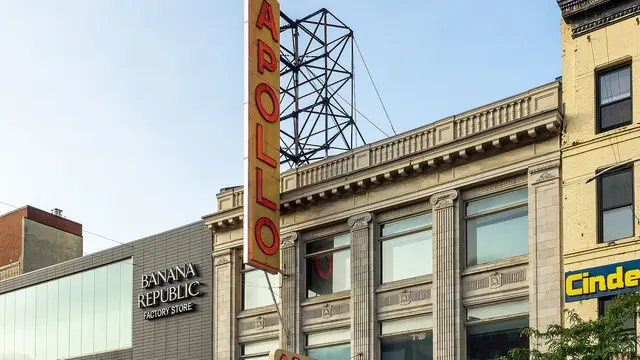
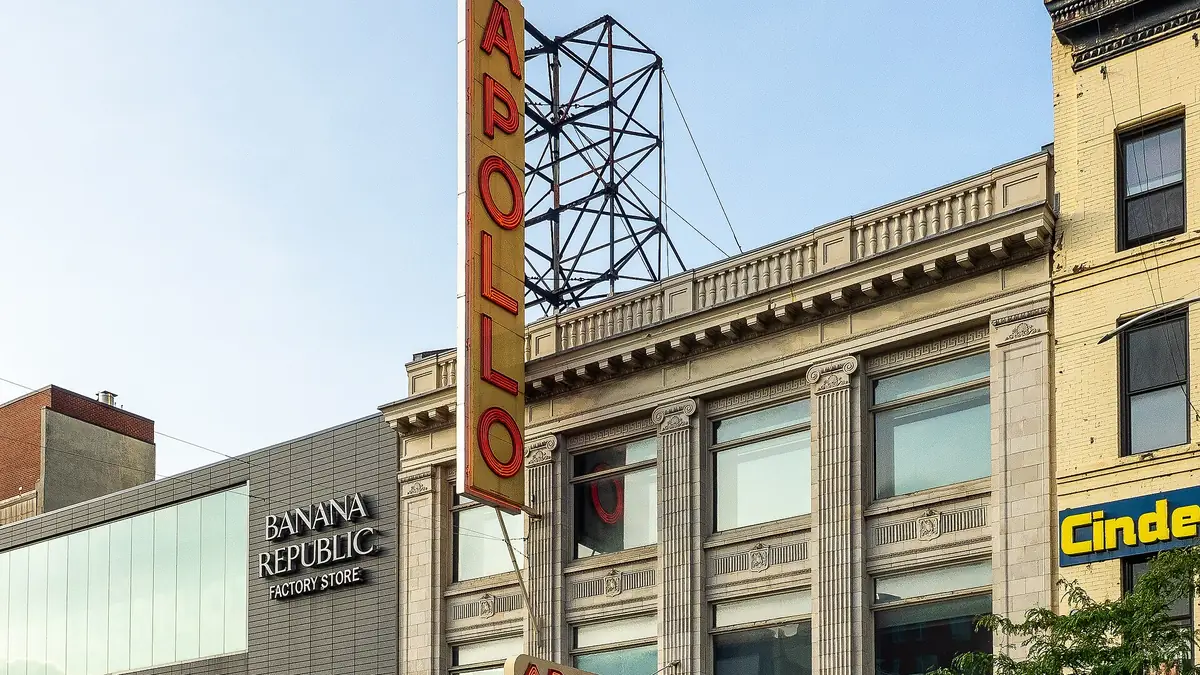
The current project, designed by Beyer Blinder Belle, broke ground on June 30, 2025. It doubles the lobby, adds a café and bar, restores the plasterwork and installs new orchestra seating. The relit marquee was switched on June 10, 2026, ahead of the planned reopening. The adjacent Victoria Theater, a 1917 vaudeville house restored and reopened in 2024, is the Apollo's first expansion in its history. For background, see the Apollo Theater entry on Wikipedia.
Frequently asked questions
Is the Apollo Theater open right now?
As of October 2026, the historic theater is closed for renovation. The Apollo anticipates reopening beginning in late 2026, with a public opening in spring 2027, and programming including Amateur Night runs at The Apollo Stages at the Victoria next door.
How many seats does the Apollo Theater have?
The historic theater holds about 1,500 people across the orchestra and two balcony levels. The interim Victoria spaces are much smaller, with a 199-seat theater and a 99-seat theater.
What are the best seats at the Apollo?
The center orchestra from the middle rows back gives the best balance of sound and sightlines, and the front of the lower balcony is strong for Amateur Night because you see the stage and the crowd. Avoid the far sides of the orchestra and the rear rows under the balcony overhang.
What subway goes to the Apollo Theater?
Take the A, B, C or D train to 125th Street and St. Nicholas Avenue, about a block west of the theater. The Victoria entrance is on the same block of West 125th Street.
Is Amateur Night appropriate for kids?
The Apollo describes Amateur Night as family-friendly with all ages welcome. Content can vary by act, so parents of young children may want to check the specific show listing.
What is the Apollo's bag policy?
As of October 2026, bags are searched and must fit under your seat, and oversized bags are prohibited. Outside food and drink are not allowed, so check the venue's current policy before you go.
Sources
- Wikipedia – Apollo Theater
- The Apollo – History
- The Apollo – Visit
- The Apollo – Summer 2026 season
- The Apollo – Renovation designs unveiled (Aug. 2024)
- The Apollo – Groundbreaking on renovation (June 2025)
- The Apollo – Marquee relighting (June 2026)
- Time Out New York – Apollo closing for renovation
- 6sqft – Victoria Theater reopens
- Wikipedia – Live at the Apollo (1963 album)