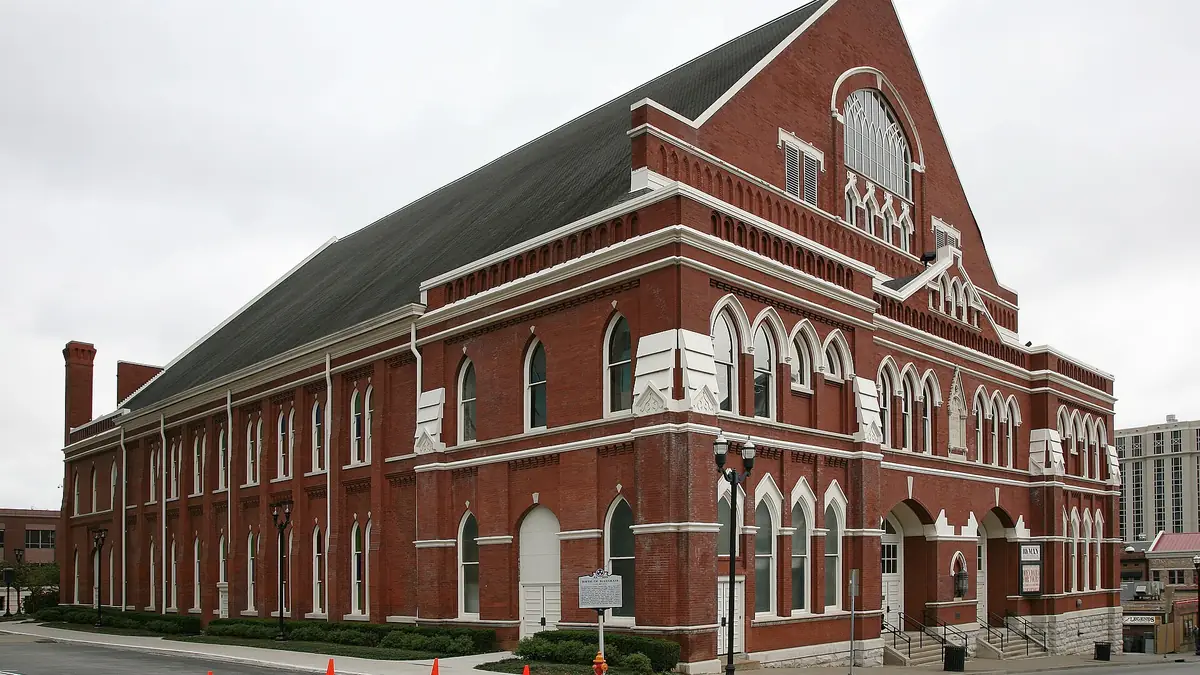

Looking for section numbers and the best seats by level? See the Ryman Auditorium Seating Chart.
Upcoming events at Ryman Auditorium
Dates and live ticket listings appear here as soon as they are on sale. The guide below covers what to know before you buy.
The Mother Church of Country Music
The Ryman Auditorium is a 2,362-seat concert hall in downtown Nashville, built in 1892 as a gospel tabernacle and best known as the home of the Grand Ole Opry from 1943 to 1974. Today it books a wide mix of country, rock, Americana, hip-hop and stand-up comedy, and it runs daytime tours when no show is loading in.
The building began as the Union Gospel Tabernacle, built by Nashville businessman Thomas Ryman after he attended a revival led by the evangelist Samuel Porter Jones. It was renamed for Ryman after his death in 1904. Its Opry years earned it the nickname the Mother Church of Country Music, and Pollstar has named it Theater of the Year 13 times.
The hall sits half a block north of Lower Broadway, between Fourth and Fifth Avenues, with the main entrance on the Fourth Avenue side.
Main floor, balcony and the pews
The Ryman has two seating levels, and almost every seat is a wooden pew rather than an individual chair.
- Main floor: rows of original oak pews from 1895 facing the stage, with the closest rows only a few steps from the performers.
- Balcony: added in 1897 and shaped in a broad U that curves around the sides of the room. Its far ends were removed in the 1993 to 1994 renovation, so it no longer runs all the way to the back wall. The balcony is the upper level, not a separate box section.
Pews change the experience in two ways. Legroom is tight, and seat space is shared, so a row of large-framed fans in winter coats feels crowded. Seats are still numbered individually on the ticket, but there are no armrests marking your space.
The balcony was long known as the Confederate Gallery; in 2017 the inscription was replaced with one that reads 1892 Ryman Auditorium.
Where to sit, and the seats with a catch
The posts are the main thing to watch
Columns that hold up the balcony rise through the main floor, and for some seats under and behind the balcony overhang a post blocks part of the stage. The back of the main floor also sits under the balcony, which flattens the sound slightly and cuts off the view of the upper stage and lighting. If a seat map flags a seat as obstructed or limited view, believe it.
Good picks
- Main floor, front and middle center: the closest and most direct view in the room, and the first to go for high-demand shows.
- Balcony front rows, center: often the best overall seats in the building. You look straight over the main floor onto the stage, the post problem disappears, and the hall's sound carries well up there.
- Balcony sides: closer to the stage than the center balcony, but angled, so expect to turn your head and to lose a slice of the far side of the stage.
Seats to weigh carefully
- Rear main floor under the balcony: cheaper for a reason, with posts and a lower ceiling.
- Back rows of the balcony: still close by arena standards, but the slope is steep and the climb is long.
Some artists allow fans to stand at their seats for the whole show. If you need to sit, the balcony usually stays seated longer than the front of the main floor.
Shows, tours and when demand peaks
With only about 2,400 seats, the Ryman sells out quickly for artists who could fill an arena, and multi-night runs are common. Friday and Saturday nights, holiday weeks and any show that doubles as a recording or a special event draw the most demand. Weeknight comedy and multi-night residencies are often easier to get into.
The Grand Ole Opry has returned periodically. Starting in November 1999 it spent its November through January shows at the Ryman each winter through the 2019 to 2020 season, and it came back for January runs in 2023 and 2024. Check the Opry's calendar for any current winter dates.
On non-show hours, self-guided and backstage tours run daily, with the venue listing tour hours of 9 a.m. to 4 p.m. and shorter schedules on event days.
Parking, rideshare and walking in
- Parking: the Fifth + Broadway garage sits directly across the street. Other downtown garages and app-based parking cover the surrounding blocks, but rates rise sharply on weekend nights.
- Walking: most visitors already staying downtown walk in. The hall is a half block up from Broadway, a few minutes from the honky-tonks and from Bridgestone Arena.
- Rideshare: drop-off is simple, but pickup after a show competes with Broadway traffic, so walking a block or two away before requesting a car usually helps.
- Driving in: from I-40, take the Broadway exit heading east toward downtown.
Plan for a busy night downtown when the Ryman, Bridgestone Arena and a Titans game or convention overlap.
Bags, entry and accessibility
As of 2025, the Ryman prohibits oversized bags and weapons, and every guest goes through security screening. Camera rules depend on the promoter for each show; professional cameras with detachable lenses are not allowed. Complimentary wheelchair escorts are available at the entrances to help guests reach their seats. Check the Ryman's current visitor FAQ before you go, since rules can change for individual shows.
Every GoodSeats order is backed by a 100% guarantee.
A short history of the Ryman
Long before the Opry arrived, the tabernacle hosted concerts as well as revivals; Enrico Caruso sang there in 1919. During the Opry years, Bill Monroe and the Bluegrass Boys performed on its stage in 1945. Later, The Johnny Cash Show was recorded in the auditorium from 1969 to 1971.
After the Opry moved to its new home in 1974, the building sat largely unused and deteriorating for nearly 20 years, though it never closed to visitors. A renovation brought it back as a concert hall, reopening with a broadcast of A Prairie Home Companion on June 4, 1994. A 2015 expansion added larger lobbies, more restrooms and the Cafe Lula restaurant. The Ryman was designated a National Historic Landmark in 2001 and a Rock and Roll Hall of Fame Landmark in 2022.
Frequently asked questions
How many seats does the Ryman Auditorium have?
The Ryman seats 2,362, split between the main floor and a U-shaped balcony. Nearly all seating is on wooden pews.
Are there obstructed view seats at the Ryman?
Yes. Posts that support the balcony block part of the stage from some main-floor seats under the overhang. Seats flagged as limited view on the seating map are the ones to check.
Is the balcony at the Ryman a good place to sit?
Often, yes. The front rows of the center balcony look straight onto the stage with no posts in the way, and many regulars prefer them to the rear main floor.
Where do you park for the Ryman Auditorium?
The Fifth + Broadway garage directly across the street is the closest option. Other downtown garages and app-based parking are nearby, and many visitors staying downtown simply walk.
Can you tour the Ryman Auditorium?
Yes. Self-guided and backstage tours run daily, with listed hours of 9 a.m. to 4 p.m. and modified schedules on show days.
Does the Grand Ole Opry still play at the Ryman?
The Opry moved out in 1974 but has returned for winter runs, most recently in January 2023 and 2024. Check the Opry's calendar for current Ryman dates.