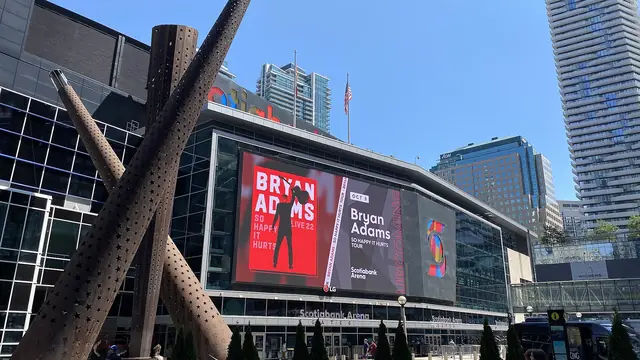
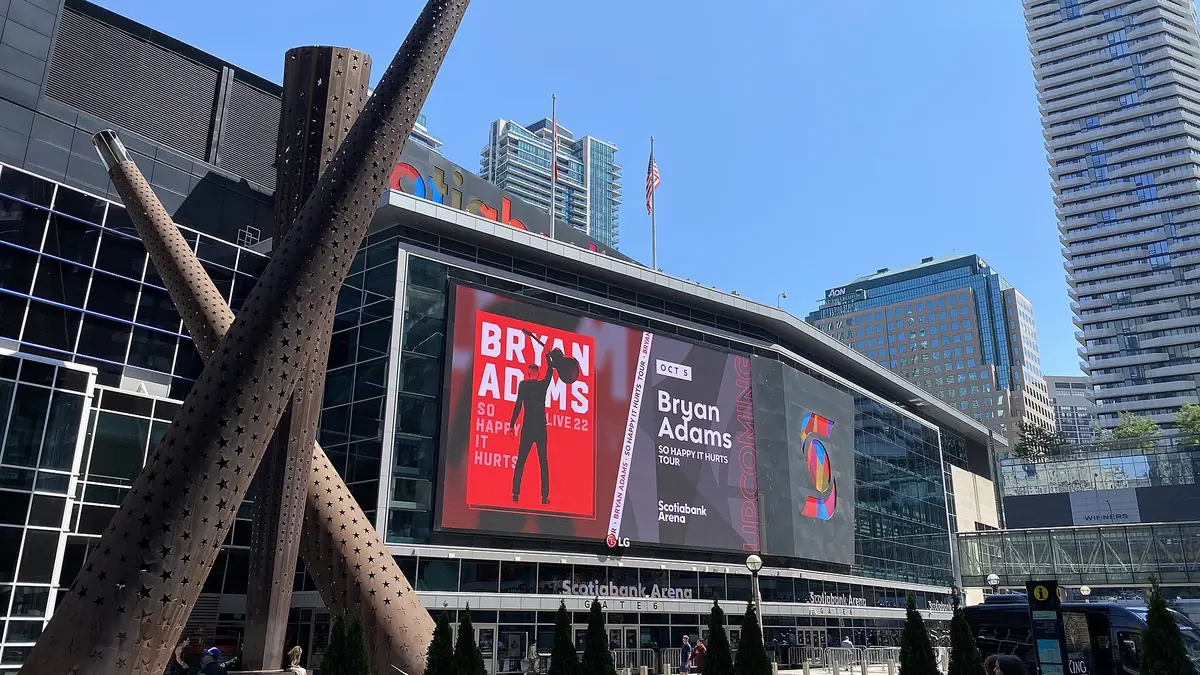

Looking for section numbers and the best seats by level? See the Scotiabank Arena Seating Chart.
Upcoming events at Scotiabank Arena
No upcoming events are scheduled at Scotiabank Arena at this time, so there are no tickets to list. New events will appear here as soon as they are announced and tickets go on sale. In the meantime, the guide below covers what to know before you buy.
Toronto's arena for the Leafs, the Raptors and major tours
Scotiabank Arena is the indoor arena at 40 Bay Street in downtown Toronto, home of the NHL's Toronto Maple Leafs and the NBA's Toronto Raptors. Seating capacity is 18,819 for hockey (20,270 with standing room) and 19,800 for basketball (20,511 with standing room). Concert capacity is listed at about 19,800, and a smaller theater configuration seats about 5,200.
The arena opened on February 19, 1999, and carried the Air Canada name until July 1, 2018, when it became Scotiabank Arena. Many fans still call it the ACC. It is owned and operated by Maple Leaf Sports & Entertainment (MLSE), which also owns both main tenants.
Beyond the two main teams, the arena hosts occasional games by the AHL's Toronto Marlies, the G League's Raptors 905 and the PWHL's Toronto Sceptres, plus arena concert tours, UFC cards and family shows. Hockey and basketball together fill most winter and spring nights, with the busiest stretch from October through April.
How the 100 and 300 levels are laid out
The public seating sits in two main bowls with suite rings between and above them:
- The 100 level (sections 101 to 122): the lower bowl wrapping the rink or court. For basketball, courtside seats sit on the floor in front of it; for concerts, the floor holds lettered sections.
- The suite levels: private suites and lounges ring the building between and above the bowls.
- The 300 level (sections 301 to about 324): the upper bowl, steeper and farther from the ice, with the arena's least expensive seats. Gondola boxes are sold separately.
On both levels, the center sections of each long side of the rink or court are the most sought after, and the corners and ends follow. Check a seat map for the specific event, since concert setups close or reshape some sections.
Best seats for hockey, basketball and concerts
Maple Leafs games
For hockey, the sideline of the 100 level, 10 or more rows up, is the best seat in the house: high enough to see over the glass and read plays developing, close enough to hear the game. The first few rows behind the glass feel close but distort the far side of the ice. End-zone 100-level seats are good for watching your team attack twice, but the far end of the rink looks small.
The front rows of the 300 level along the sides are the value choice. Hockey watches well from height, and these seats see the full sheet of ice and every line change. The top rows of the 300 level in the corners are the farthest seats in the building.
Raptors games
Basketball rewards being low. Lower-level sideline seats near center court give the best view; the end sections of the 100 level, behind the baskets, look through the stanchion and glass and lose depth. In the 300 level, sideline seats near center court are far more useful than corner seats.
Concerts
Most concerts use an end-stage layout, so the 100-level sections along the sides, near the stage, give the best combination of sightline and sound. Floor seats are closest but flat, so a tall crowd in front can block the view. Sections directly behind the stage are usually closed or sold as limited-view seats.
What drives demand
Leafs tickets are among the most sought after in the NHL, and demand peaks on Saturday nights and against Original Six rivals such as the Montreal Canadiens, plus playoff dates. Raptors demand rises on weekends and for visits from star-driven teams. Midweek games early in the season usually offer the widest choice.
Getting there through Union Station
Location is the arena's big advantage. Scotiabank Arena connects to Union Station, Toronto's main transit hub, through the underground PATH network, so you can reach your gate without going outside, a real benefit in January. Union Station links to the TTC subway and streetcars and to GO Transit regional trains, which carry fans from across the Greater Toronto Area.
Driving is the weaker option. As of the arena's current guide, the on-site underground garage serves mainly suite holders and building tenants for a flat, card-only fee, with a 2-meter height limit, and it opens an hour before events. The nearest public garage is the underground lot at 15 York Street under Maple Leaf Square. Reserving parking in advance through an app is the usual way to avoid circling downtown after the game. Check the arena's getting-here page for current details.
The small-bag rule and other entry policies
Scotiabank Arena's bag rule is stricter than many North American venues. As of its current policy, only small purses, clutches or fanny-pack-style bags smaller than 16.5 by 11.5 centimeters (about 6.5 by 4.5 inches) are permitted. Backpacks and larger bags must be checked at a paid bag check in the galleria across from Gate 1, and x-ray screening is available at Gates 1, 3 and 5 for medical and other exceptions. Check the arena's bag policy before you go, since the rules can change.
The arena is cashless, so plan on paying for food, drinks and parking by card or phone.
Maple Leaf Square, Legends Row and the building's past
The arena was built inside part of the former Toronto Postal Delivery Building, constructed from 1938 to 1941. Its Art Deco limestone facade survives, with bas-relief sculptures by Louis Temporale Sr. showing the history of Canadian transportation. The architects were Brisbin Brook Beynon, with HOK Sport consulting.
Maple Leaf Square, the development next to the arena, opened in 2010, and its outdoor plaza fills with fans watching on big screens during playoff runs. Legends Row, a set of statues honoring 14 former Maple Leafs, stands at the arena.
Major events give the building its history: Games 1, 2 and 5 of the 2019 NBA Finals during the Raptors' championship run, the 2016 NBA All-Star Game (the first held outside the United States), the 2000 and 2024 NHL All-Star Games, the 2004 and 2016 World Cups of Hockey, and the 2017 Invictus Games ceremonies. MLSE announced a multi-phase renovation in October 2023 that includes expanded concourses and new technology, so some areas may change from season to season.
Frequently asked questions
What is the seating capacity of Scotiabank Arena?
Scotiabank Arena seats 18,819 for hockey and 19,800 for basketball. With standing room, capacity rises to 20,270 for hockey and 20,511 for basketball.
What is Scotiabank Arena's capacity for concerts?
About 19,800 for a full arena concert, and a smaller theater configuration seats about 5,200. For hockey the arena seats 18,819 and for basketball 19,800, before standing room.
What was Scotiabank Arena called before?
It opened in 1999 under the Air Canada name and was often called the ACC. It became Scotiabank Arena on July 1, 2018.
Can you bring a bag into Scotiabank Arena?
As of the current policy, only small purses, clutches or fanny packs smaller than about 6.5 by 4.5 inches are allowed. Larger bags go to a paid bag check across from Gate 1.
How do you get to Scotiabank Arena by transit?
Take the TTC subway or a GO train to Union Station, then follow the indoor PATH connection to the arena.
Where is the best place to sit for a Maple Leafs game?
Sideline seats in the 100 level, 10 or more rows up, give the best view of the full ice. The front rows of the 300 level along the sides are the best value.