.jpg)
Upcoming events at Target Field
Dates and live ticket listings appear here as soon as they are on sale. The guide below covers what to know before you buy.
The Twins' open-air ballpark in the North Loop
Target Field is the home of the Minnesota Twins, an open-air ballpark that opened in 2010 in the North Loop, the old warehouse district on the west edge of downtown Minneapolis. It seats 38,544 by the most common count, though some guides list about 39,500.
The park is squeezed onto an eight-acre site bounded by rail lines, a freeway and two streets on bridges, so it is compact and vertical. A light rail and commuter rail station sits right at the gates.
- Twins baseball: late March or early April through September. April and late-September games can be cold, and summer weekends draw the biggest crowds.
- Other events: stadium concerts in summer, occasional college football, and the 2022 NHL Winter Classic.
Target Field seating chart: decks, clubs and outfield seats
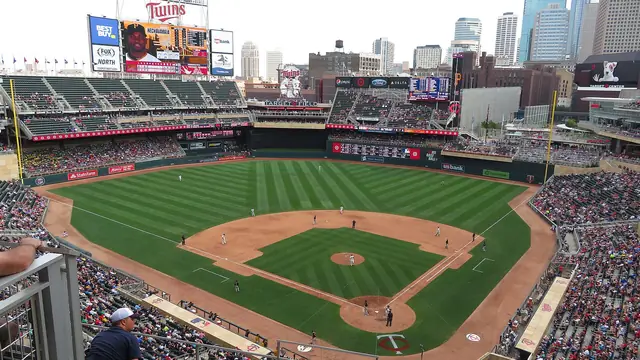
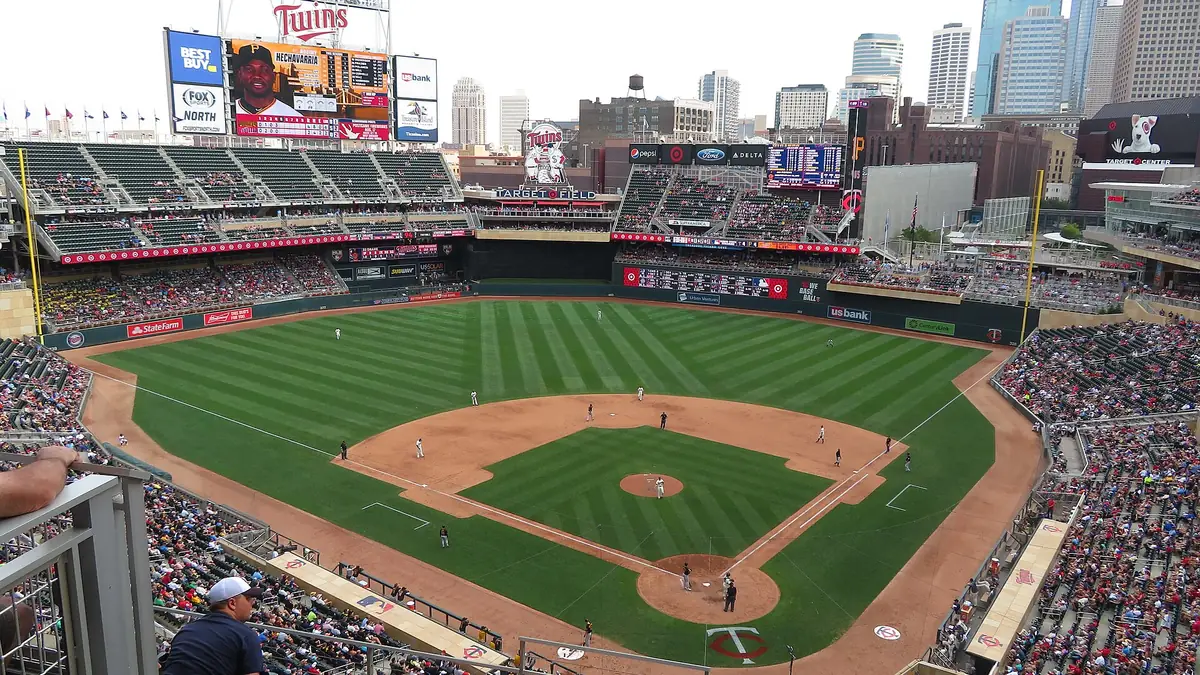
The ballpark stacks its seats in three main tiers around the infield, with grandstands in the outfield:
- Lower deck: about 19,000 seats wrapping the field from foul pole to foul pole, the largest share of the park.
- Club level: about 7,000 club seats by the ballpark's published breakdown, including indoor and outdoor premium areas behind home plate and along the infield.
- Upper deck: about 13,500 seats, much of it under the canopy that hangs over the top of the deck.
- Outfield: a double-decked grandstand in left field and additional seating in right field, plus the Budweiser Roof Deck beyond the outfield with fire pits for cool nights.
The bullpens are in left-center field, with the visiting bullpen in front of the Twins' bullpen. Exact section ranges and dugout sides vary by source, so use the interactive seat map at checkout to confirm where a section sits relative to the infield and the sun.
Best seats, sun and shade, and seats to avoid
The diamond is aligned to the east, meaning home plate points toward center field in that direction. For afternoon games the sun moves across the south and west, which shapes where you will be comfortable:
- Shade first: seats behind home plate and along the first-base side, which face away from the afternoon sun, and the upper deck under the canopy.
- Sun longest: the third-base side and the left-field seats, which face south and west into the afternoon light. That is welcome in April and September and harsh in July.
- Best overall view: lower-deck seats between the dugouts, roughly 10 to 25 rows back, high enough to see over the on-deck activity and close enough to read pitches.
- Best value: the front rows of the upper deck behind home plate and the infield, which show the whole field and the downtown skyline over the outfield.
Seats to think twice about: the deep corners of the lower deck near the foul poles, which face the outfield rather than the plate, and the back rows of the lower deck under the overhang, where high fly balls disappear from view. In early-season night games, the canopy-covered upper deck and the heated concourses matter more than proximity; dress for temperatures well below the daytime high.
Gates, Target Plaza and what the park looks like inside
Five main gates are named for Twins greats: Gate 3 (Harmon Killebrew) at Fifth Street and Third Avenue, Gate 6 (Tony Oliva) at Target Field Station, Gate 14 (Kent Hrbek) on Seventh Street, and Gates 29 (Rod Carew) and 34 (Kirby Puckett) on Target Plaza. The plaza is the main gathering spot, with a large bronze glove, statues of Killebrew, Carew, Puckett and Joe Mauer, and the original flagpole from Metropolitan Stadium.
Inside, the exterior is clad in Kasota limestone quarried in Minnesota, the field is heated and so are many concourse areas, restrooms and lounges. The Minnie and Paul sign in center field, based on the club's classic handshake logo, lights up when a Twins player homers.
Getting there: light rail, Northstar and the parking ramps
- Light rail and commuter rail: Target Field Station, at Fifth Street North and Fifth Avenue North, is the terminus of the METRO Blue and Green lines and the Northstar commuter line. Gate 6 opens onto it, which makes rail the simplest way in from much of the Twin Cities and the northern suburbs served by Northstar.
- Parking: the ABC Ramps (Ramps A, B and C) sit next to the ballpark, and the Twins sell reserved game-day parking there and in the Hawthorne Ramp. As of the 2026 season the team encourages paying online in advance; check the current rates before you go.
- Biking and walking: the North Loop and downtown are walkable, and many fans eat in the North Loop before the game.
After the game, trains at Target Field Station board at the start of their routes, so you can usually get a seat by walking straight to the platform rather than waiting out the ramp exits.
Target Field bag policy, food rules and gate times (2026 season)
As of the 2026 season, the Twins allow single-compartment bags up to 16 by 16 by 8 inches, including purses, clear bags and drawstring bags. Backpacks, multi-compartment laptop bags, duffel bags and anything larger than the limit are not allowed. The team offers free storage for prohibited bags near Gate 6.
- Outside food: allowed, but not in hard-sided containers such as plastic storage tubs, hard coolers or thermoses. Outside food is not permitted in bars, restaurants or suites.
- Gate times: one hour before Monday through Thursday evening games, 90 minutes before weekday afternoon games and two hours before Friday through Sunday games.
- Families: family restrooms with changing stations are spread around the park, and Sunday games feature a Kids Day.
Check the venue's current policy at the Twins' Target Field information guide before you go. Every GoodSeats order is backed by a 100% guarantee, including guaranteed entry.
A short history of Target Field
Target Field was designed by Populous and built for about 555 million dollars, funded by the Twins, a Hennepin County sales tax and separate infrastructure money. The first regular-season game, on April 12, 2010, ended Twins 5, Red Sox 2.
The park hosted the 2014 MLB All-Star Game and, on January 1, 2022, the NHL Winter Classic, won 6–4 by the St. Louis Blues over the Minnesota Wild. Concerts by Paul McCartney, the Eagles and Kenny Chesney have played here, and a P!nk show on August 10, 2023 set the attendance record at more than 45,000. In 2017 it hosted a Division III college football game between St. Thomas and St. John's in front of 37,355 fans.
Frequently asked questions
What is the capacity of Target Field?
Target Field seats 38,544 by the most commonly cited count, though some guides list about 39,500. Concerts with field seating have drawn more than 45,000.
Does Target Field have a roof?
No. It is open air, but a canopy covers much of the upper deck, and the field and many concourse areas are heated.
What is the Target Field bag policy?
As of the 2026 season, single-compartment bags up to 16 by 16 by 8 inches are allowed. Backpacks, multi-compartment laptop bags and duffels are not, and free storage is available near Gate 6.
Can you bring food into Target Field?
Yes, outside food is allowed as of 2026, but not in hard-sided containers, and not into bars, restaurants or suites.
Where do I park for Target Field?
The ABC Ramps next to the ballpark and the Hawthorne Ramp offer reserved game-day parking that can be bought online in advance.
Which seats are in the shade at Target Field?
Seats behind home plate, along the first-base side and under the upper-deck canopy get shade first in day games. The third-base side and left field stay in the sun longest.