.jpg)
Looking for section numbers and the best seats by level? See the Barclays Center Seating Chart.
Upcoming events at Barclays Center
Dates and live ticket listings appear here as soon as they are on sale. The guide below covers what to know before you buy.
Brooklyn's Arena at Atlantic and Flatbush
Barclays Center is the indoor arena at 620 Atlantic Avenue in Brooklyn, at the corner of Atlantic and Flatbush Avenues, opened on September 21, 2012. It is home to the Brooklyn Nets (NBA) and the New York Liberty (WNBA), it hosts the NBA Draft, and it is a major stop for concert tours, boxing and wrestling. It seats 17,732 for basketball and up to about 20,000 for concerts. The short answer on seats: the center sections of the lower bowl are the best views in the building, and the low rows of the center 200 level are the best value.
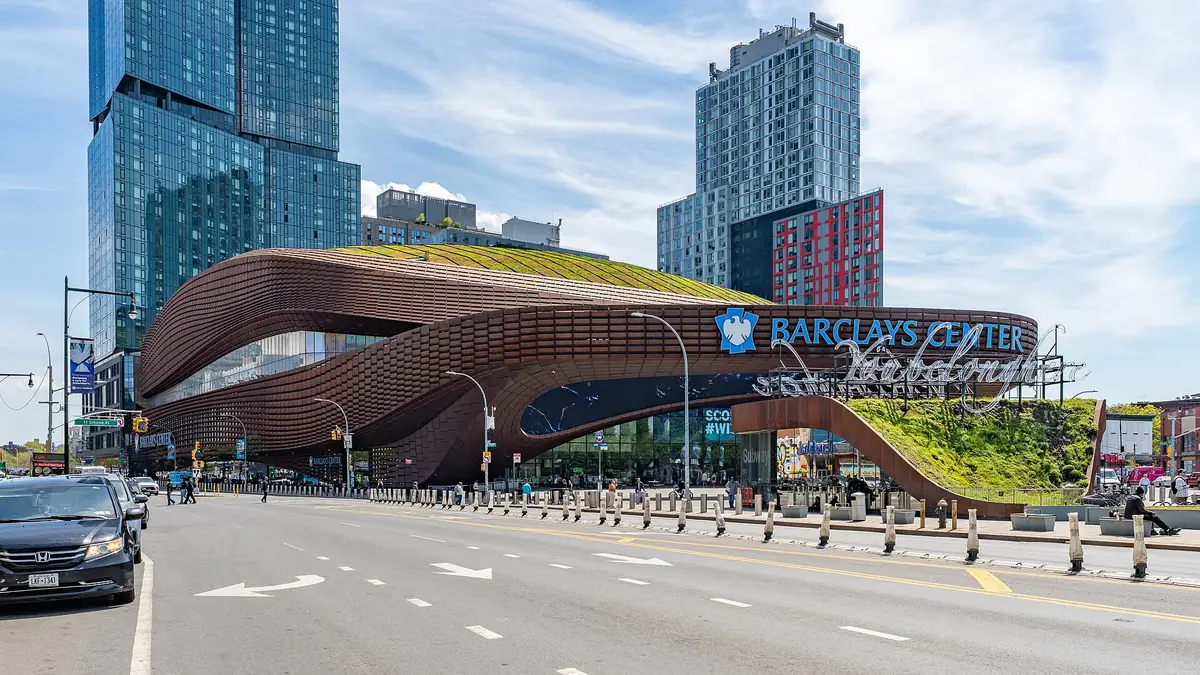
The arena was designed for basketball first, and that shows in how close the seats feel for a game. Its look is distinctive too: about 12,000 pre-weathered steel panels wrap the exterior, and a 117-by-56-foot oculus with a built-in screen hangs over the plaza. The arena floor sits below street level, so people on the plaza can see the center-hung scoreboard through the glass.
Reading the Section Numbers
Barclays Center numbers its seats in a way that confuses first-time buyers, because the lower bowl does not use 100-level numbers.
- Floor and courtside: seats on the court, marked with an F prefix on many charts.
- Lower bowl, sections 1–31: the main lower ring. Sections 7–9 and 23–25 are at center court; sections 1, 15–17 and 31 sit behind the baskets. Rows run to about row 19.
- 100-numbered sections: a smaller band of seats and premium boxes at the top of the lower bowl, with only a few rows.
- 200 level, sections 201–231: the upper bowl. Center sections (about 206–210 and 222–226) run to roughly row 22; end and corner sections are shorter.
Seating guides place the Nets bench in front of section 7. Premium clubs and lounges change names with sponsorships, so judge a listing by its section and row, not by the club label.
Best Seats for Nets, Liberty and Concerts
Basketball
Center sections 7–9 and 23–25 in the lower bowl are the premium views. Corner sections such as 3–4 and 19–20 are a smart compromise: you still see both ends, and prices usually step down. The low rows behind the baskets are the weakest lower-bowl seats, because the stanchion and the players on the near baseline block much of the far court. In the upper bowl, rows 1–8 in the center 200s give a clean, full-court view at a fraction of the lower-bowl premium.
Concerts
Most shows use an end stage at one baseline, which removes or limits the sections directly behind it. Side sections in the lower bowl nearest the stage are the strongest seats. The center 200s on the sides also work well because the arena is compact. Floor tickets put you closest, but on a flat floor the view depends on the crowd in front of you.
Boxing and wrestling
A center ring makes every side a front. Lower-bowl seats on any side are good, and the 200 level gains value because the action stays in one spot.
Sightlines and Seats to Avoid
- Behind-the-stage seats at concerts. Buy them only when the listing says they are side or rear view and you accept that.
- Low rows behind the baskets. Exciting for a dunk, poor for following a game.
- Hockey sightlines. When the New York Islanders played here from 2015 to 2020, the arena's basketball-first shape left one end of the rink partly hidden from upper sections 201–204 and 228–231. If a hockey or ice show is booked, read those listings with care.
- Top rows of the corner 200s. These are the farthest seats from the floor and usually the least expensive; they are fine for a casual night but not for a big game.
Demand runs highest for marquee Nets opponents, Liberty playoff games, NBA Draft night and big-name concert tours, and resale prices tend to climb in the final days before a sellout. Every GoodSeats order is backed by a 100% guarantee.
Subway, LIRR and Why Not to Drive
Barclays Center sits on top of one of Brooklyn's largest transit hubs. The Atlantic Avenue–Barclays Center station serves the 2, 3, 4, 5, B, D, N, Q, R and W trains, and the Long Island Rail Road ends at Atlantic Terminal across the street. Several bus routes, including the B41 and B45, stop nearby.
Driving is a poor choice. The arena has no dedicated parking lot, which is unusual for a major American venue, and the arena itself describes nearby parking as very limited. If you must drive, reserve a garage in advance. After an event, walking a few blocks away from Atlantic and Flatbush before requesting a rideshare avoids the worst of the gridlock. The arena's A to Z guide lists current transit and parking details.
Bags, Tickets and Entry Rules
Barclays Center's bag rule is stricter than at most New York arenas. As of fall 2026, the posted rules include these; check the venue's current policy before you go.
- Bags larger than 10 by 6 by 2 inches are not allowed, which rules out most purses and all but the smallest crossbody bags.
- Backpacks are prohibited at any size.
- Express lanes are open to guests carrying no bag at all.
- Tickets are mobile only; printed tickets and screenshots do not scan, and barcodes appear 24 to 72 hours before the event.
- No re-entry is allowed at any event.
- Concessions are cash-free, with kiosks outside sections 7, 23 and 31 that convert cash to a prepaid card.
Add the ticket to your phone's wallet before you leave home so it opens quickly at the scanner.
How the Arena Came to Brooklyn
Developer Bruce Ratner's Forest City Ratner proposed the arena in 2004 as the centerpiece of the Atlantic Yards project, now called Pacific Park. Eminent domain fights, lawsuits and the recession delayed it for years before ground was broken on March 11, 2010. The site has an older echo: in the 1950s, a domed stadium for the Brooklyn Dodgers was proposed just to the north, where the Atlantic Terminal mall now stands.
Ratner bought the New Jersey Nets in 2004 to move them to Brooklyn, and their arrival in 2012 returned major league sports to the borough for the first time since the Dodgers left for Los Angeles in 1957. Jay-Z opened the arena with concerts beginning September 28, 2012. Joseph Tsai took full control of the Nets and the arena in 2019. The Liberty moved in for 2021 and won their first WNBA title on the home floor in 2024, beating Minnesota 67–62 in Game 5.
Frequently asked questions
What is the capacity of Barclays Center?
Barclays Center seats 17,732 for basketball, 15,795 for hockey, about 16,000 for boxing and up to about 20,000 for concerts.
What size bag can I bring into Barclays Center?
As of fall 2026, bags larger than 10 by 6 by 2 inches are not allowed and backpacks are prohibited. Guests with no bag can use express lanes, and the venue's current policy should be checked before you go.
Is there parking at Barclays Center?
There is no dedicated arena parking lot, and nearby parking is very limited. Ten subway lines and the LIRR stop at or beside the arena, so transit is the better option.
What are the best seats at Barclays Center for a Nets game?
Center-court lower-bowl sections 7–9 and 23–25 have the best views. For value, the first several rows of the center 200-level sections give a full-court view at lower prices.
Why does Barclays Center have no 100-level lower bowl numbers?
The main lower bowl is numbered 1–31, with a small band of 100-numbered seats above it and the upper bowl numbered 201–231. Read listings by section number rather than assuming a 100 means the lower bowl.
Can I print my Barclays Center tickets?
No. As of fall 2026, entry is mobile only and screenshots are not accepted, so add the ticket to your phone's wallet ahead of time.