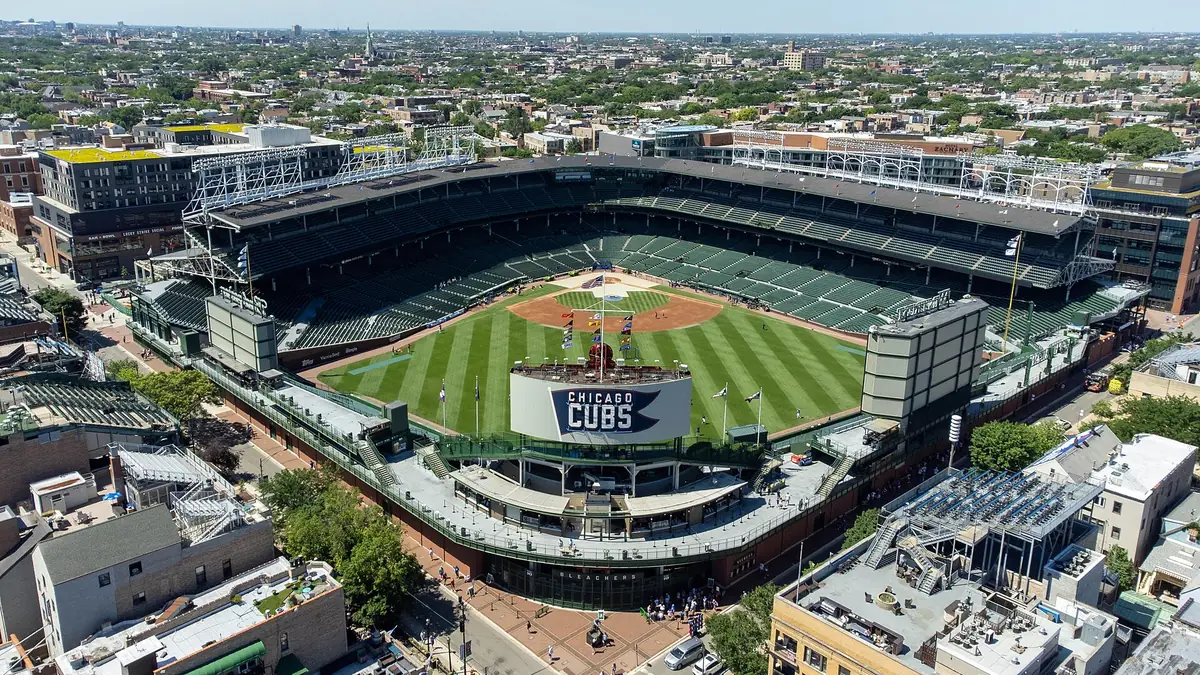

Looking for section numbers and the best seats by level? See the Wrigley Field Seating Chart.
Upcoming events at Wrigley Field
Dates and live ticket listings appear here as soon as they are on sale. The guide below covers what to know before you buy.
The Cubs' ballpark on Clark and Addison
Wrigley Field is the home of the Chicago Cubs, an open-air ballpark at 1060 West Addison Street in the Lakeview neighborhood on Chicago's North Side. It opened on April 23, 1914, and seats 41,649 for baseball. Among active Major League parks, only Fenway Park in Boston, which opened in 1912, is older.
The Cubs have played here since April 20, 1916. Baseball runs from late March or early April through September, with the postseason in October when the team qualifies. Outside the baseball calendar, the park has hosted summer stadium concerts since 2005 and two NHL Winter Classic games: January 1, 2009, and December 31, 2024, both featuring the Chicago Blackhawks.
What sets Wrigley apart for a ticket buyer is that the building is old, compact and surrounded by a residential neighborhood. That means close sightlines from many seats, but also support poles, overhangs and very little parking. The sections below explain how to use that to your advantage.
How Wrigley's sections are numbered
Starting on Opening Day 2019, the Cubs moved to a standard Section/Row/Seat system. The levels now read from the field outward and upward:
- Club and box seats sit in the first rows around home plate, closest to the field.
- 100 level (field box) is the lower bowl, the seats nearest the field from foul pole to foul pole.
- 200 level (terrace) rises behind the field boxes and sits under the upper deck. The first few rows (terrace box) are in front of the support poles; the rest is terrace reserved.
- 300 level (upper box) is the front of the upper deck, numbered as the 400s before 2019.
- 400 level (upper reserved) is the rear of the upper deck, a short stack of rows under the roof.
- 500 level (bleachers) wraps the outfield. Bleacher seats are general admission during the regular season and assigned during the postseason.
Upper-level sections carry an "L" or "R" suffix, such as 303L or 431R, to show whether they sit on the left-field or right-field side. That suffix tells you which ramp or stairway to use, so it is worth noting before you arrive.
Where to sit at a Cubs game, and which seats to skip
For the clearest view of the game
The 100-level field boxes between the bases put you close enough to hear the infield chatter. Behind home plate and down to each dugout is where demand, and resale pricing, runs highest. Down the lines toward the corners, the seats stay close to the field but angle you toward the outfield rather than the plate.
For value with a full view
The 300-level upper box behind home plate is the best-kept option in the park. The Cubs themselves describe these premium upper seats as comparable to 200-level seats at other ballparks. You see the whole field, the ivy and the manual scoreboard, and you are free of support poles.
For atmosphere
The bleachers are the social center of the park. Because they are general admission in the regular season, the ticket buys entry, not a specific spot, so arrive when the gates open if you want a front-row bench in left or right field.
Seats to think twice about
- Terrace reserved rows near the poles. Steel posts hold up the upper deck, and in many 200-level sections the first pole falls around row 6 (in section 230 it falls near row 17). Rows in front of the poles or roughly rows 10 to 15 usually see more of the field. Check the row before you buy.
- The back rows of the terrace. The upper deck overhang cuts off high fly balls and the outfield video boards.
- Bleachers on a hot afternoon. The 500 level has no roof, and day games here are common.
Sun and shade
For day games, the third-base side becomes the shade side as the afternoon goes on. The 200-level terrace is shaded by the deck above, and the 400 level sits under the roof. The first-base side and the right-field corner (including sections 29 to 32, 129 to 134 and 327 to 331) take the most direct sun.
For concerts
Concert layouts change by tour, and some seats near or behind the stage may be closed or sold as limited view. Use the event-specific map for the show rather than the baseball chart.
Getting to Wrigleyville: take the Red Line
The ballpark sits in a dense neighborhood with little parking, and the Cubs encourage fans to use public transit. The CTA Red Line stops at Addison, steps from the park. The Brown and Purple lines and several CTA bus routes also serve the area, and Metra riders can connect from downtown stations to the L. The Cubs transportation page lists current options, including Pace shuttle service.
Driving is possible but slow. There is on-site parking, designated rideshare drop-off zones and a bike valet. After the final out, expect crowds on the Addison platform; walking a few blocks before hailing a ride usually saves time.
Bags, entry and what to bring
As of the 2026 season, Wrigley Field allows soft-sided bags, purses, drawstring bags and soft coolers no larger than 16 by 16 by 8 inches. Backpacks are not allowed, and that includes clear backpacks. Hard-sided coolers are prohibited regardless of size. Empty plastic bottles are permitted. Fans pass through touchless metal detectors that do not require emptying pockets of phones, wallets and keys.
Policies change, so check the Cubs ballpark security page before you go. For an April or September night game, bring a layer; the wind off Lake Michigan can make the park far colder than the forecast suggests.
Gallagher Way, the rooftops and the neighborhood
Gallagher Way is a public plaza on the west side of the park at Clark and Addison. The Cubs opened it in 2017 as the Park at Wrigley, and it took its current name in 2018. It hosts concerts, movie screenings and pregame activities during baseball season. The Hotel Zachary, built as part of the ballpark renovation, opened across Clark Street in April 2018.
Beyond the outfield walls, private rooftop clubs on the surrounding buildings sell their own game-day packages. Under a 2004 agreement, rooftop owners shared revenue with the team, and by the end of 2016 the Ricketts family, which owns the Cubs, had bought ten of the rooftop properties. Rooftop seats are a different product from the ballpark itself, with a distant view of the field and a party setting.
A short history of the Friendly Confines
The park opened in 1914 as Weeghman Park, home of the Chicago Whales of the short-lived Federal League. The Cubs moved in two years later; the park was renamed Cubs Park in 1920 and Wrigley Field in 1927.
- 1934: the marquee over the main entrance went up; it was painted red in 1960.
- 1937: Bill Veeck planted the outfield ivy, and the hand-turned center-field scoreboard was installed. A ball lodged in the ivy is still a ground-rule double.
- 1921 to 1970: the Chicago Bears played here and hosted five NFL Championship Games.
- 1988: Wrigley became the last Major League park to install lights. The first official night game was August 9, 1988, against the New York Mets.
- 2014 to 2019: the privately funded 1060 Project rebuilt the bleachers, added outfield video boards and restored the facade.
- 2020: the ballpark was designated a National Historic Landmark on September 23, adding to its 2004 Chicago Landmark status.
Frequently asked questions
What is the capacity of Wrigley Field?
Wrigley Field seats 41,649 for baseball. Concert and special-event capacities vary with the stage layout.
Are bleacher seats at Wrigley Field assigned?
No, not during the regular season. Bleacher tickets in the 500 level are general admission, so the best spots go to fans who arrive early; seats are assigned in the postseason.
Which side of Wrigley Field is in the shade?
For afternoon games, the third-base side becomes the shade side as the day goes on. The 200-level terrace and the 400-level upper reserved sections are covered by the structure above.
Can I bring a backpack to Wrigley Field?
As of the 2026 season, no. Backpacks, including clear ones, are prohibited, while soft-sided bags up to 16 by 16 by 8 inches are allowed. Check the Cubs' current policy before you go.
What is the best way to get to Wrigley Field?
Take the CTA Red Line to Addison, which stops next to the ballpark. Parking in the neighborhood is limited, and post-game traffic is slow.
Does Wrigley Field have obstructed-view seats?
Yes. Support poles stand in many 200-level terrace sections, often around row 6. Seats in front of the poles, or roughly rows 10 to 15, usually see more of the field.