
Upcoming Chicago Cubs dates
Dates and live ticket listings appear here as soon as they are on sale. The guide below covers what to know before you buy.
The Cubs in brief: an old franchise with a long memory
The Chicago Cubs play their home games at Wrigley Field on the North Side of Chicago, and the regular season runs from late March or early April through the end of September. The franchise traces its roots to 1870, played as the White Stockings, Colts and Orphans, and has been the Cubs since 1903. It is a member of the National League Central division (since 1994).
The club has won three World Series: 1907, 1908 and 2016. The 1907 and 1908 teams were the first to win back-to-back titles. The 2016 championship ended a 108-year drought, and the victory parade drew a crowd estimated at about 5 million people. The Cubs also hold 17 National League pennants.
The rivalries that shape demand are the St. Louis Cardinals, the Milwaukee Brewers (a division rival a short drive to the north) and the crosstown Chicago White Sox. Team colors are blue, red and white, and the club has retired numbers 10, 14, 23, 26 and 31, plus 42 for Jackie Robinson across baseball.
Wrigley Field: a 1914 ballpark with a modern rebuild underneath
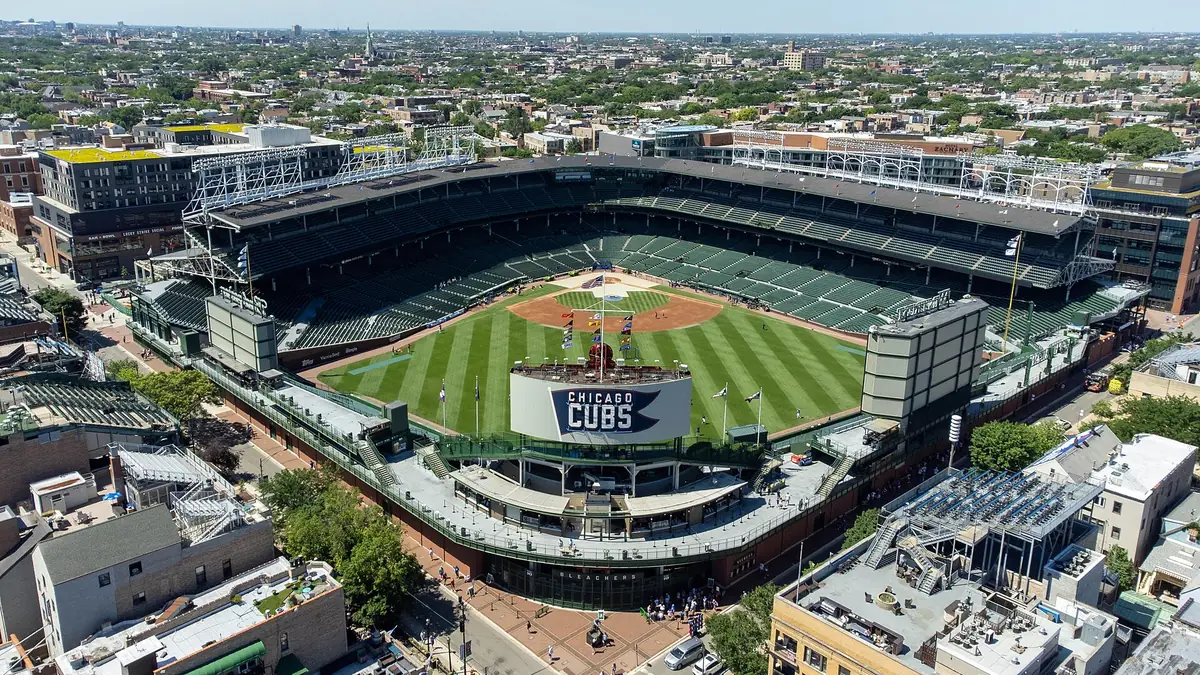
Wrigley Field opened on April 23, 1914, as Weeghman Park, became Cubs Park in 1920 and took the Wrigley name in 1927. The Cubs moved in for the 1916 season. The ballpark sits at 1060 West Addison Street, holds about 41,649, and was designated a National Historic Landmark on September 23, 2020.
Three features define it. The outfield walls are covered in Boston ivy planted in 1937. The center-field scoreboard, also from 1937, is still turned by hand. And lights arrived only in 1988, making Wrigley the last major league park to add them; the first official night game was August 9, 1988, against the New York Mets.
The 1060 Project, a privately funded renovation from 2014 to 2019, rebuilt much of the infrastructure, expanded the bleachers, added video boards and premium clubs, and moved both dugouts farther down the foul lines. The dimensions are compact: 355 feet down the left-field line, 400 to center and 353 to right. Because the park is small and open, the day's wind matters more here than in most parks: check the flags before deciding whether to expect a slugfest.
Where to sit at Wrigley: dugouts, shade, poles and the bleachers
Wrigley has four seating zones: the field box (the lower level closest to the field), the terrace (the 200-level rows at the back of the lower deck, under the upper deck), the upper deck (400 and 500 sections) and the bleachers (general-admission benches beyond the outfield walls).
Cubs dugout vs. visitors dugout
The Cubs use the third-base dugout. Seating guides place the club box infield seats behind it in sections 8 through 12, with the visitors' side mirrored in sections 23 through 27 on the first-base line. The club box home plate sections, 13 through 22, sit between the dugouts. Behind-the-dugout seats are the most requested in the building for home fans, and they price that way.
Sun and shade
The sun sets over the third-base side, so that side of the park shades first during afternoon games. The right-field lower level and most of the bleachers sit in direct sun. For a July day game, the higher rows on the third-base side are the comfortable choice; in one section guide, rows 7 and up behind the Cubs dugout are shaded for most late-afternoon games while the first few rows are not.
Terrace poles: the trade-off for a roof
The terrace level is covered by the upper deck, which keeps you dry, but the deck is held up by steel columns. Guides report poles around row 6 in many terrace sections and at the ends of others. Middle rows (roughly 10 to 15) and seats away from the section ends reduce the risk. Check a seat-view photo before buying any terrace seat.
Upper deck and bleachers
The upper deck is shallow (about nine rows in the upper reserved) and gives the best full view of the field and the rooftops across Waveland and Sheffield avenues, though the front row has poles at some section ends. The bleachers are general admission: you buy a bleacher ticket, not a seat, and the best spots go to whoever is in line first. The benches are metal and backless, the sun is direct, and the crowd is the loudest in the park. The team designates a portion of the bleachers for fans who want a calmer atmosphere.
The schedule and the games that sell first
Spring training runs in February and March at Sloan Park in Mesa, Arizona, which opened in 2014 and seats about 15,000, the largest spring park in the majors. The regular season runs from late March or early April into late September, and the postseason follows in October when the club qualifies.
Demand at Wrigley follows a few predictable patterns:
- Opening Day and the first homestand, regardless of weather.
- The Cardinals series, which brings a large St. Louis contingent and fills the bleachers early.
- The crosstown series with the White Sox, when it is played on the North Side.
- Summer weekends, especially Saturday afternoon games from June through August.
- The Brewers series, since Milwaukee fans make the short trip in numbers.
Weeknight games in April and September against out-of-division opponents are the usual value dates. Resale prices for those games often soften in the final days before first pitch, while rivalry and summer weekend dates tend to hold or rise.
Getting to Addison Street and the gameday routine
Take the CTA Red Line to the Addison station, which lets out next to the ballpark. Wrigley sits in a dense residential neighborhood with very little parking, so driving to the door is the slowest option. The Cubs offer free remote parking with a shuttle for night and weekend games; check the team's current details before you go.
As of the 2026 season, the Cubs list these policies on the team's ballpark guide (check the current version before you go):
- Tickets are mobile only, scanned from the MLB Ballpark app; screenshots are not accepted.
- Bags larger than 16 by 16 by 8 inches are prohibited, including backpacks; medical and diaper bags are exceptions.
- Gates generally open 90 minutes before first pitch, and two hours early for Opening Day and Saturday games.
- Payments inside the park are cashless, with cash-to-card machines available.
- Smoking is prohibited across the campus, including Gallagher Way, the plaza next to the ballpark.
There is no tailgating culture at Wrigley in the stadium-lot sense. The pregame happens in the bars and restaurants on Clark and Addison and on Gallagher Way. If you have a bleacher ticket, plan to arrive well before the gates open to claim a front-row spot.
Following the Cubs on the road
Cubs fans are a fixture in road ballparks across the Midwest. Milwaukee and St. Louis are the classic road trips, both within a half-day drive of Chicago, and Cubs crowds there can rival the home crowd. Spring training in Mesa is another popular trip, since Sloan Park's capacity makes it easier to find seats than at most Cactus League parks. For a road series, buy early for weekend dates in Milwaukee and St. Louis, where both fan bases compete for the same seats.
Every GoodSeats order is backed by a 100% guarantee, so a ticket for Wrigley or a road park is covered if something goes wrong with the order.
Moments that built the Cubs story
- 1907 and 1908: back-to-back World Series titles, the first in baseball history.
- 1937: the ivy and the hand-turned scoreboard arrive at Wrigley.
- August 9, 1988: the first official night game at Wrigley, against the Mets.
- 2016: the World Series title that ended a 108-year wait, followed by a parade estimated at about 5 million people.
- 2020: Wrigley Field is designated a National Historic Landmark.
- 2025: the club returned to the postseason for the first time since 2020, beat the Padres in the Wild Card Series and lost the Division Series to the Brewers.
For schedules and team news, see the Cubs' official site, and for current entry rules see the Wrigley Field ballpark guide.
Frequently asked questions
Which dugout do the Cubs use at Wrigley Field?
The Cubs use the third-base dugout. Seating guides list sections 8 through 12 behind it, with the visiting team on the first-base side in front of sections 23 through 27.
Are Wrigley Field bleacher seats assigned?
No. The bleachers are general admission, first come, first served. Arrive well before the gates open if you want a front-row spot.
Which seats at Wrigley Field are in the shade?
The third-base side shades first because the sun sets over it, and the terrace level is covered by the upper deck. The right-field lower level and most of the bleachers sit in direct sun.
Do terrace seats at Wrigley Field have obstructed views?
Some do. Steel columns support the upper deck, and guides report poles near row 6 and at the ends of many terrace sections. Middle rows and seats away from section ends are safer.
What is the best way to get to Wrigley Field?
The CTA Red Line to Addison stops next to the ballpark. Neighborhood parking is scarce; the Cubs offer free remote parking with a shuttle for night and weekend games, so check current details before you go.
How many World Series have the Cubs won?
Three: 1907, 1908 and 2016. The 2016 title ended a 108-year championship drought.