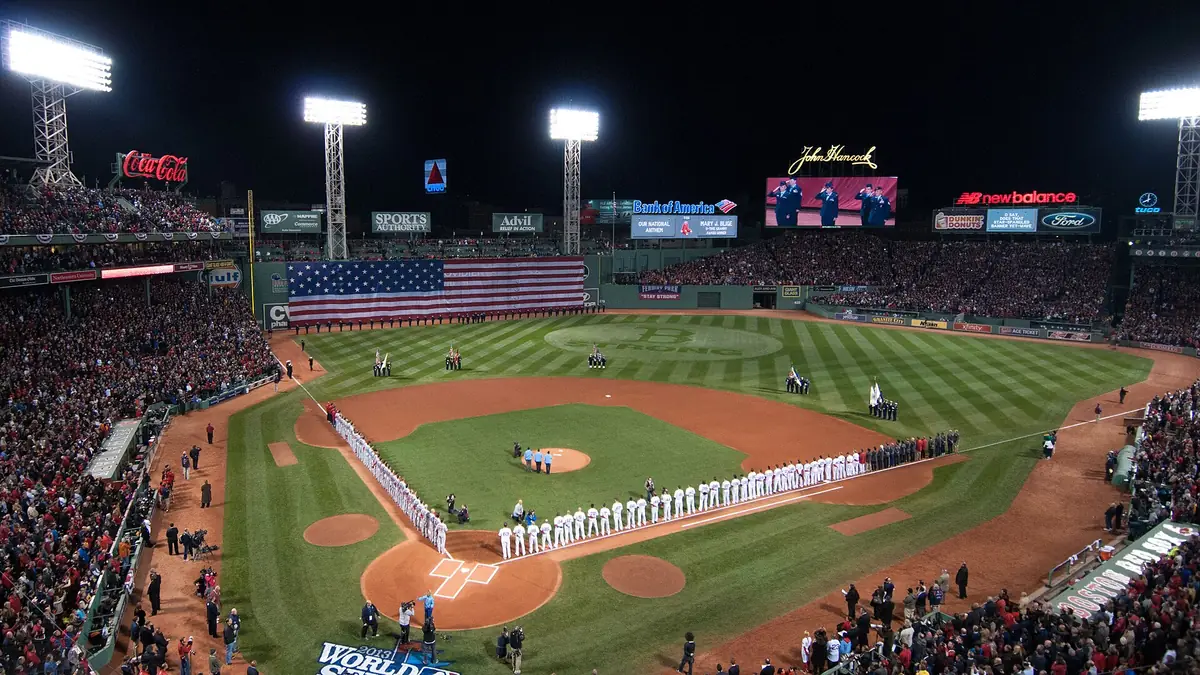

Looking for section numbers and the best seats by level? See the Fenway Park Seating Chart.
Upcoming events at Fenway Park
Dates and live ticket listings appear here as soon as they are on sale. The guide below covers what to know before you buy.
The Red Sox home since 1912
Fenway Park is the home of the Boston Red Sox and the oldest active ballpark in Major League Baseball. It opened on April 20, 1912, at what is now 4 Jersey Street, near Kenmore Square. Capacity is 37,305 for day games and 37,755 for night games; the difference comes from center-field seats that are covered with a black tarp during day games to give hitters a dark background, known as the batter's eye.
The Red Sox season runs from spring into September, with October baseball when the team reaches the postseason. Fenway also books summer concerts, a tradition dating to 2003, and has hosted the NHL Winter Classic twice, in 2010 and 2023.
The park was built for a 1912 city block, not a modern seating plan. The field is irregular, many seats are narrow, and some face the outfield rather than home plate. Knowing those quirks is the difference between a great afternoon and three hours of craning your neck.
Reading Fenway's odd-shaped field and seating map
Start with the field, because it shapes every view. Left field is only 310 feet from home plate, and the Green Monster, a wall just over 37 feet tall, makes up for it. Center field reaches 420 feet at the Triangle. Right field ends at Pesky's Pole, 302 feet away, the shortest outfield distance in the majors.
The seating areas, from the field outward:
- Dugout Box, Field Box and Loge Box are the lower seats around the infield. Field and Loge boxes run about 12 rows each with padded seats.
- Grandstand rises behind the boxes and wraps most of the field under the upper deck. These are the original-style wooden seats, about 15 inches wide.
- Right Field Box continues the lower level down the right-field line.
- Pavilion and club areas sit on the upper level: Pavilion Box seats along the sides, the Dell Technologies Club behind home plate, the Lansdowne Pavilion and the Right Field Roof Box.
- Green Monster seats sit on top of the left-field wall, with barstools along the rail. They were added before the 2003 season.
- Bleachers fill center and right field, about 50 rows deep.
- Standing room is sold in several designated areas around the park.
Seats worth the money and seats to avoid
Support poles in the grandstand
The upper deck rests on steel columns that rise through the grandstand. Poles most often fall near the first or last seat of a row and in rows 2 to 4 of many grandstand sections. If a listing shows an obstructed view, believe it. Middle seats, roughly seats 5 through 12, are the safer pick, and a seating view tool is worth checking before you buy.
Right-field seats that face the wrong way
The Right Field Box seats and parts of the right-field grandstand point toward center field, not home plate. You will turn your head for every pitch. The angle is worst near Pesky's Pole, around sections 5 and 93. These seats can look like a bargain on a map; for a long game they are a poor choice.
Best overall values
- Loge and Field boxes between the dugouts are the best lower seats, and they carry the highest resale demand.
- Pavilion Box seats on the upper sides give a clear, high view of the whole field with more legroom than the grandstand, and rows C and up are covered.
- Infield grandstand away from the poles is the classic Fenway seat at a lower price than the boxes.
Green Monster seats
The Monster seats are a once-in-a-lifetime ticket for many fans, and demand reflects that. You look down on the left fielder and across the whole park, though plays at the wall directly below you are hard to see. Treat them as an experience rather than the best view of the game.
Bleachers and the red seat
The bleachers are lively and generally less expensive, but the upper rows are among the farthest seats from home plate in the majors and have no shade. One bleacher seat is painted red: Section 42, Row 37, Seat 21, marking where Ted Williams's 502-foot home run landed on June 9, 1946.
Sun and rain
The grandstand stays out of the sun and rain for the most part, thanks to the deck overhead. The bleachers and Monster seats are fully exposed, so bring a hat and sunscreen for a day game.
Getting to Fenway on the T
Parking near Fenway is scarce, and the area's streets fill up hours before first pitch. Public transit is the practical choice. The MBTA Green Line stops at Kenmore, a short walk from the park, and at Fenway station on the D branch. Commuter rail trains stop at Lansdowne station, a short walk from the park. Check the MBTA for game-day service changes.
Lansdowne Street, which runs behind the Green Monster, and Jersey Street, outside the main entrance, are the two main pregame gathering spots. After the game, Kenmore station gets crowded; walking to a station farther down the line can be quicker.
Bag rules and entry at Fenway
As of the 2026 season, bags must be single-compartment and no larger than 12 by 12 by 6 inches. Clear bags are encouraged. Backpacks and backpack-style purses are not allowed, with exceptions for diaper bags and bags holding medical equipment. Cans, bottles and glass are prohibited except for one sealed plastic bottle of water up to 16 ounces, and outside alcohol is banned. Every fan passes through metal detectors.
Review the Red Sox security page before you go, since the rules can change by season or event.
More than a century of Fenway history
Fenway opened in April 1912 and hosted the World Series that fall, which the Red Sox won. The team also won titles in 1918, 2004, 2007, 2013 and 2018. The Boston Braves borrowed the park for the 1914 World Series.
- The manual scoreboard in the left-field wall is still updated by hand during games.
- The Monster seats, added for 2003, turned the top of the wall into one of the most sought-after tickets in baseball.
- The address changed in 2018, when the street outside, named Yawkey Way since 1977, reverted to Jersey Street.
- The ballpark joined the National Register of Historic Places on March 7, 2012, in its centennial year.
Frequently asked questions
What is the capacity of Fenway Park?
Fenway Park holds 37,305 for day games and 37,755 for night games. Center-field seats are tarped during day games to create a batter's eye.
Is Fenway Park the oldest ballpark in MLB?
Yes. Fenway opened on April 20, 1912, and is the oldest active Major League ballpark. Wrigley Field, from 1914, is next.
Are Green Monster seats worth it?
For the experience, many fans think so. They give a high view of the whole park, but plays at the base of the wall below you are hard to follow.
How do I avoid obstructed-view seats at Fenway?
In the grandstand, avoid the first and last seats of a row and rows 2 to 4 where support poles commonly stand. Also skip the right-field box seats if you want to face home plate.
Can I bring a backpack to Fenway Park?
As of the 2026 season, no. Bags must be single-compartment and no larger than 12 by 12 by 6 inches, with exceptions for diaper and medical bags.
What is the best way to get to Fenway Park?
Take the MBTA Green Line to Kenmore or Fenway station, or commuter rail to Lansdowne. Parking near the park is limited.