
Looking for section numbers and the best seats by level? See the SoFi Stadium Seating Chart.
Upcoming events at SoFi Stadium
Dates and live ticket listings appear here as soon as they are on sale. The guide below covers what to know before you buy.
The NFL stadium that hosts two teams and the biggest tours
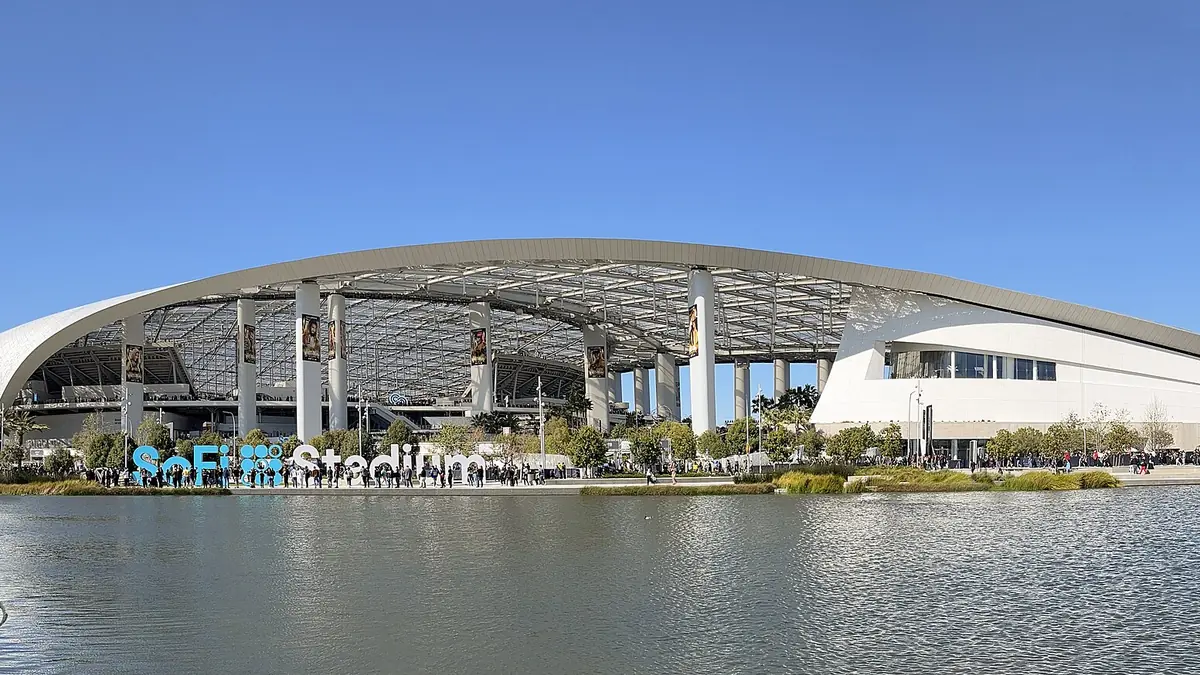
SoFi Stadium is the 70,240-seat home of both the Los Angeles Rams and the Los Angeles Chargers, built on the former Hollywood Park racetrack site in Inglewood, about three miles from LAX. It opened in September 2020 and can expand past 100,000 for special events. Beyond NFL Sundays, it books stadium concerts, college football, WrestleMania and international soccer, so the building hosts major events through most of the year.
Two design choices shape every visit. First, the playing field sits 100 feet below street level, a requirement of FAA height limits under the LAX flight path. Second, a translucent canopy (an ETFE roof, a lightweight fluoropolymer film stretched over a steel frame) covers the bowl while the sides stay open to ocean air. The result is an indoor-outdoor stadium: shaded and protected from rain, but open to the breeze rather than sealed.
Because two teams share the building, the stadium hosts roughly twice the usual number of NFL home dates. That spreads demand out. A Rams or Chargers game against a non-rival often draws a mixed crowd and a wider spread of resale listings than a sold-out concert does.
How the seating bowl is organized
Sections are numbered by level, and the first digit tells you the tier:
- 100 level: the field-level seats that ring the playing surface and sit closest to the action.
- 200 level: the club tier, with access to indoor lounges such as the United Club and the Delta Sky360 Club.
- 300 to 500 levels: the upper tiers, which climb toward the canopy and hold most of the building's lower-cost seats.
Because the bowl is sunk into the ground, many fans enter near street level and walk down to their seats rather than climbing ramps, and concourses and club spaces extend all the way down to field level. Plan for stairs both ways if you sit low.
Hanging over the field is the Infinity Screen, a double-sided oval video board made by Samsung that covers about 70,000 square feet. Its two faces point outward to the stands and inward toward the field, so nearly every seat faces a screen. Seating guides generally place the home bench on the west sideline for both the Rams and the Chargers. Confirm the sideline on the seat map for your specific game before you pay a sideline premium.
Best seats for football, concerts and soccer
Football
The strongest view of a football game comes from the sidelines between the 20-yard lines, about 15 rows up or higher in the 100 level, where you see over the benches and the players standing in front of them. The first handful of rows at field level look close on a map, but in practice they sit at eye level with the sideline crowd. Higher rows show you play develop.
For value, the lower rows of the 300 level along the sidelines are often the smartest buy in the building: the angle is high enough to read formations, and the Infinity Screen is right in front of you. The 200 club seats cost more because they bundle lounge access and less crowded concourses, which matters more on a hot afternoon than on a cool night.
Seats to think twice about: low rows behind the end zones, where the far end of the field flattens out, and the very top rows of the 500 level, which are a long climb and a long way from the field.
Concerts
Most stadium tours build an end stage at one end of the field. The best balance of sound and sightline is usually the 100 level along the sides, angled toward the stage, or the lower 200 level directly across from it. Floor seats put you closest but are flat, so anyone behind the first rows watches over heads and on the screens. Avoid sections at sharp angles beside the stage, where speaker stacks and set pieces can block part of the show; a seat map with a stage overlay for your specific date is worth checking.
Demand patterns
Resale prices move with the opponent, the stakes and the calendar. Division rivals, late-season games with playoff seeding at stake and prime-time kickoffs draw the most demand. Multi-night concert runs tend to see the opening and closing nights priced higher than the middle dates.
What each level looks like from the seat
From the 100 level, the field fills your view and the canopy feels far overhead. The sunken design means even lower seats have some rake (the slope of the seating tiers), so sightlines are better than at older stadiums with shallow lower bowls.
The 200 level gives the classic television angle: high enough to see all 22 players, low enough to feel connected to the field. From the 300 through 500 levels the view widens to the whole stadium, including the canopy and the Infinity Screen at roughly eye level. The upper tiers feel high, but the bowl is compact for its size, and the open sides let in natural light and breeze.
The canopy covers the seats, but the sides are open. Late in the day low sun can slip in under the canopy edge and catch some rows, so sunglasses are worth bringing to an afternoon kickoff.
Getting to Inglewood: Metro, shuttles, parking and rideshare
No rail line stops at the door, so most fans combine transit with a shuttle, park on site or use rideshare. Leave extra time on any of them: Inglewood traffic builds well before kickoff, especially when the neighboring Kia Forum or Intuit Dome also has an event.
- Metro rail plus shuttle: the stadium directs riders to take the Metro C or K Line to the LAX/Metro Transit Center station, where a game-day shuttle runs from Bus Bay 8. For past major events, Metro has also run shuttles from the C Line's Hawthorne/Lennox station.
- Regional express buses: GTrans Line 7X, Torrance Transit and Culver CityBus Line 99 have run round-trip game-day service.
- Parking: on-site lots are split into color-coded zones across Hollywood Park, and passes are digital, so download the pass to your phone before you leave home. The city's Inglewood Park and Go remote lots run shuttles to the transit facility beside the stadium.
- Rideshare: drop-off is on the northbound curb of Kareem Court, and pickup is on Kareem Court near Manchester Boulevard. Expect surge pricing and a long walk-and-wait after the final whistle.
Tailgating is limited. As of the 2025 season, it is allowed only in the Pink parking zone for select events, with natural gas or propane grills only (no charcoal) and no glass, and it must end at kickoff. Details and current lot maps are on the stadium's parking and transportation page.
Entry rules, bags and inside the stadium
As of 2026, SoFi Stadium enforces a clear-bag policy (bags must be clear plastic, vinyl or PVC and no larger than 12 by 6 by 12 inches) for all events. A small clutch up to about 4.5 by 6.5 inches is allowed whether or not it is clear. A paid bag check operates at several corners of the site for non-compliant bags, but it adds time, so leave the backpack in the car or at home. Check the stadium's current policy page before you go.
- Cashless: every point of sale takes cards or mobile pay only; kiosks inside convert cash to prepaid cards.
- No re-entry: once your ticket is scanned, leaving ends your visit except in an emergency.
- Gate closures: for NFL games, some gates close after the first quarter, so late arrivals may walk farther to get in.
Food and drink are spread across concourses on every level, and club tickets add indoor lounges with their own bars. The open-sided design relies on ocean breezes rather than a sealed roof, so dress for the temperature outside. Every GoodSeats order is backed by a 100% guarantee and guaranteed entry.
A short history of SoFi Stadium
Rams owner Stan Kroenke developed the stadium on the 298-acre site of the old Hollywood Park racetrack, with the architecture firm HKS. Construction ran from 2016 to 2020, and published estimates put the total cost at about 5.5 billion dollars, among the most expensive stadiums ever built. The fintech company SoFi holds a 20-year naming-rights deal.
The building's big-event resume grew quickly:
- Super Bowl LVI (February 13, 2022): the Rams beat the Cincinnati Bengals 23–20, winning a title in their own stadium.
- 2023 College Football Playoff National Championship: Georgia beat TCU 65–7.
- WrestleMania 39 (April 2023): a combined 161,892 fans attended over two nights.
- 2026 FIFA World Cup: renamed Los Angeles Stadium for the tournament under FIFA's sponsor rules, it hosted eight matches, including the US opener on June 12, 2026.
Super Bowl LXI is scheduled here for February 14, 2027, and the stadium will share the 2028 Summer Olympics opening ceremony with the Los Angeles Memorial Coliseum. Expect Super Bowl week and Olympic dates to carry the highest demand the building sees.
Frequently asked questions
What is the capacity of SoFi Stadium?
SoFi Stadium seats 70,240 in its standard configuration and can expand to more than 100,000 for special events with added seating.
Does SoFi Stadium have a roof?
Yes. A translucent ETFE canopy covers the seating bowl and field, but the sides are open, so the stadium is shaded and protected from rain without being fully enclosed.
How do I get to SoFi Stadium by public transit?
Take the Metro C or K Line to the LAX/Metro Transit Center station and transfer to the game-day shuttle from Bus Bay 8. Shuttle details can change by event, so check the stadium's transportation page beforehand.
Can you tailgate at SoFi Stadium?
Only for select events, and only in the Pink parking zone. Gas or propane grills are allowed, charcoal and glass are not, and tailgating must end at kickoff.
What bags are allowed at SoFi Stadium?
As of 2026, clear bags up to 12 by 6 by 12 inches and small clutches up to about 4.5 by 6.5 inches. Confirm the current policy before your event.
Is the Super Bowl coming back to SoFi Stadium?
Yes. Super Bowl LXI is scheduled at SoFi Stadium for February 14, 2027, the building's second Super Bowl after the Rams won Super Bowl LVI there in 2022.