
Upcoming Chicago Bulls dates
Dates and live ticket listings appear here as soon as they are on sale. The guide below covers what to know before you buy.
The franchise behind the charging-bull logo
The Chicago Bulls play home games at the United Center on Chicago's Near West Side, with a regular season that runs from late October to mid-April. The franchise was founded on January 16, 1966, the third NBA team to call Chicago home, and it plays in the Eastern Conference's Central Division.
The Bulls won six championships in eight seasons, in 1991, 1992 and 1993 and again in 1996, 1997 and 1998, with Michael Jordan and Scottie Pippen at the center of both runs. The 1995–96 team went 72–10, then an NBA record and the first 70-win season in league history. Five numbers hang retired: 1, 4, 10, 23 and 33.
The team's identity still leans on that era, but the rivalries run deeper than one decade. The Detroit Pistons, New York Knicks, Miami Heat and Cleveland Cavaliers have all been playoff opponents with real history, and those games carry a different crowd than a midweek visit from a Western Conference team. Benny the Bull, the mascot since 1969, is part of the gameday routine for families.
The United Center for a Bulls game
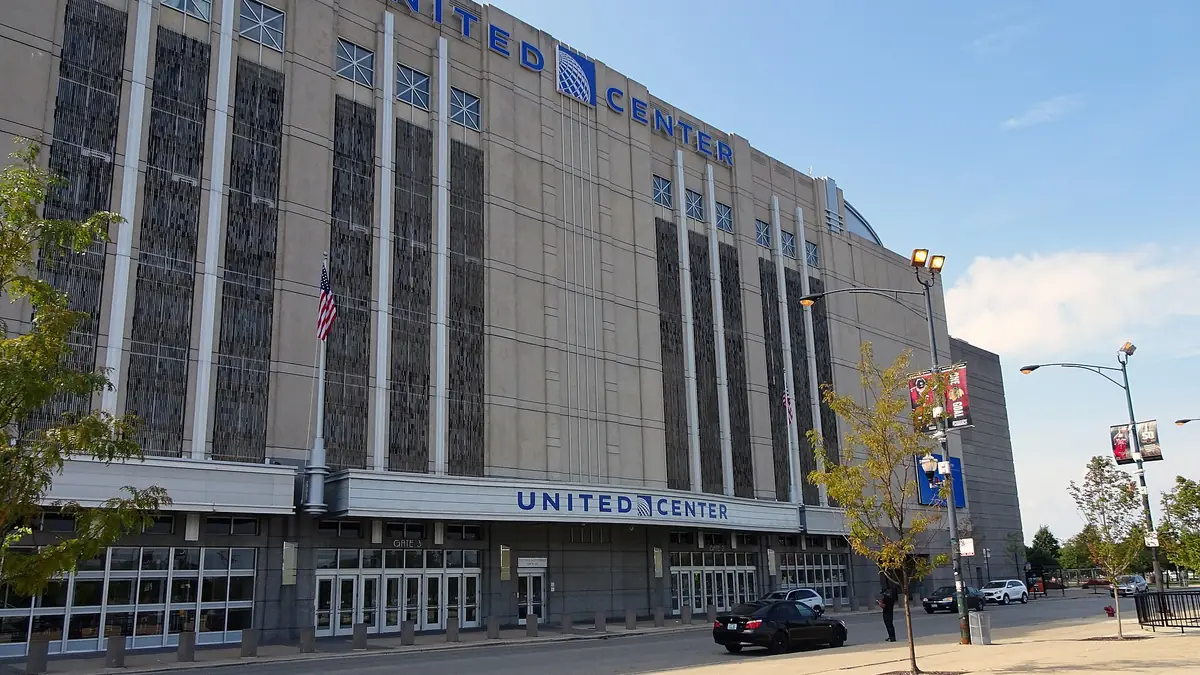
The United Center opened in August 1994 at 1901 W. Madison St., replacing Chicago Stadium, where the Bulls played from 1967 to 1994. It seats 20,917 for basketball, or about 23,100 with standing room, and the Bulls share it with the NHL's Chicago Blackhawks. The two franchises own the building jointly.
The arena is a three-level bowl:
- 100 level: the lower bowl. Most sections run 19 rows, and the center sideline sections 105 to 107 and 116 to 118 add lettered rows in front of row 1.
- 200 level: the club ring, with short sections of about eight rows and in-seat wait service.
- 300 level: the upper deck, about 17 rows per section, with standing-room areas.
Both benches sit on the same sideline. Seating guides place the Bulls bench in front of section 102 and the visitors' bench in front of section 121. The Michael Jordan statue stands in the arena's atrium, which opened in 2017, and is a common meeting point before tipoff.
Choosing a seat: sideline, baseline and the upper deck
Courtside and the lower sideline
Courtside seats (the floor-level row along the sideline) are the most expensive in the building and are priced as an experience rather than a view. For watching the game, rows 8 to 15 of the center sideline 100s are hard to beat: high enough to see over the courtside row and the scorer's table, close enough to hear the floor. Seats directly behind the benches look close on the map, but standing players and staff block the view during timeouts and key possessions.
Behind the baskets
The baseline 100s (the sections behind each basket) cost less than the sideline and give a good look at half-court sets at your end, but depth perception on the far end is poor, and the stanchion can interrupt the view from the first rows directly behind the hoop. Corner sections are the better compromise: you keep the lower-bowl atmosphere and see the full court on an angle.
The 200-level club
The center club sections, which seating guides list as 201, 202, 233, 234 and 216 to 219, give a clean full-court view from a modest height. For many fans the front rows here are a better basketball seat than a mid-row lower-bowl seat at a similar price, and the in-seat service is a real convenience for a long night.
The 300 level
The upper deck is where most budget seats sit. The first five or six rows at center court are the value pick. The top rows behind the baskets are the farthest seats in the arena, and the view of the court shrinks noticeably from there.
Season shape and the games that draw the biggest crowds
The NBA calendar has a predictable shape. Teams play a short preseason in early October, then an 82-game regular season (41 home games) that runs from late October into mid-April. Group games in the NBA Cup, the in-season tournament the league added in 2023–24, fall mostly on Tuesday and Friday nights in November, and those games count in the regular-season standings. A play-in tournament in mid-April sets the final playoff seeds, and the playoffs run from April into June.
Demand at the United Center follows a few clear patterns:
- Opponent star power: visits from the league's marquee players and the best teams in the East draw well above a typical weeknight.
- Rivals: games against Detroit, New York, Cleveland and Miami carry history and bring traveling fans, especially from Detroit and Cleveland, which are a drive away.
- Weekends and holidays: Friday and Saturday games and the holiday weeks around Christmas and New Year's sell faster than Monday through Wednesday.
- Late-season stakes: if the team is in the play-in or playoff picture in March and April, demand climbs with every game.
For a regular-season game against a non-rival, weeknight games and the stretch from January to early March usually give the widest choice of seats. Prices on the resale market can move in either direction in the final 48 hours depending on the matchup.
Getting to West Madison and what to know at the door
The United Center sits about two miles west of the Loop. The CTA has historically run the #19 United Center Express bus on game nights from Michigan Avenue and Randolph Street, along with the regular #20 Madison and #50 Damen routes. The Green and Pink lines stop at Ashland/Lake, several blocks north, and the Blue Line's Illinois Medical District stop is several blocks south. Check the CTA's current service before you go, since express routes change. Parking is available in lots around the arena, and rideshare is common, but expect traffic on Madison and Ashland after the final buzzer.
As of the 2025–26 season, the Bulls' published entry rules include:
- Mobile tickets only: fans enter Bulls games with tickets in the Bulls app; printouts and screenshots are not accepted.
- Small bags only: a small purse or personal bag up to 10 by 6 by 2 inches; backpacks are not allowed, with exceptions for medical equipment. Paid Binbox lockers in the Uber Zone near Madison and Wood streets hold larger bags.
- Cashless concessions: the arena does not accept cash for food, drinks or merchandise.
Rules change from season to season, so check the Bulls' health and safety page before you go. Every order through GoodSeats is backed by a 100% guarantee.
Bulls history worth knowing before tipoff
The Bulls began at the International Amphitheatre in 1966–67 and moved to Chicago Stadium the next season. The old stadium's noise earned it the nickname "Madhouse on Madison," and the name followed the team across the street to the United Center in 1994.
Some moments define the franchise for any fan walking in:
- "The Shot": on May 7, 1989, Jordan's buzzer-beater over Craig Ehlo won Game 5 of a first-round series in Cleveland, a moment that still shapes the Bulls–Cavaliers rivalry.
- The first three-peat: titles in 1991, 1992 and 1993.
- 72–10: the 1995–96 season, followed by the fourth title.
- The second three-peat: titles in 1996, 1997 and 1998, all won after the move to the United Center.
Later eras produced their own favorites, including Derrick Rose and Luol Deng, but the retired numbers and six championship banners in the rafters are the main reason to arrive early.
Frequently asked questions
Where do the Chicago Bulls play home games?
The Bulls play at the United Center, 1901 W. Madison St. on Chicago's Near West Side. They have played there since it opened in 1994 and share it with the Chicago Blackhawks.
How many people does the United Center hold for a Bulls game?
The United Center seats 20,917 for basketball, and capacity reaches about 23,100 with standing room.
Which side is the Bulls bench on?
Seating guides place both benches on the same sideline, with the Bulls in front of section 102 and the visitors in front of section 121.
What is the bag policy at Bulls games?
As of the 2025–26 season, only small purses or personal bags up to 10 by 6 by 2 inches are allowed, and backpacks are not. Check the Bulls' current policy before you go.
How many championships have the Bulls won?
Six: 1991, 1992, 1993, 1996, 1997 and 1998.
What are the best value seats for a Bulls game?
The front rows of the center 200-level club sections and the first few rows of the center 300 level usually offer the best view for the money. Baseline lower-bowl seats are another option if you want to be closer.